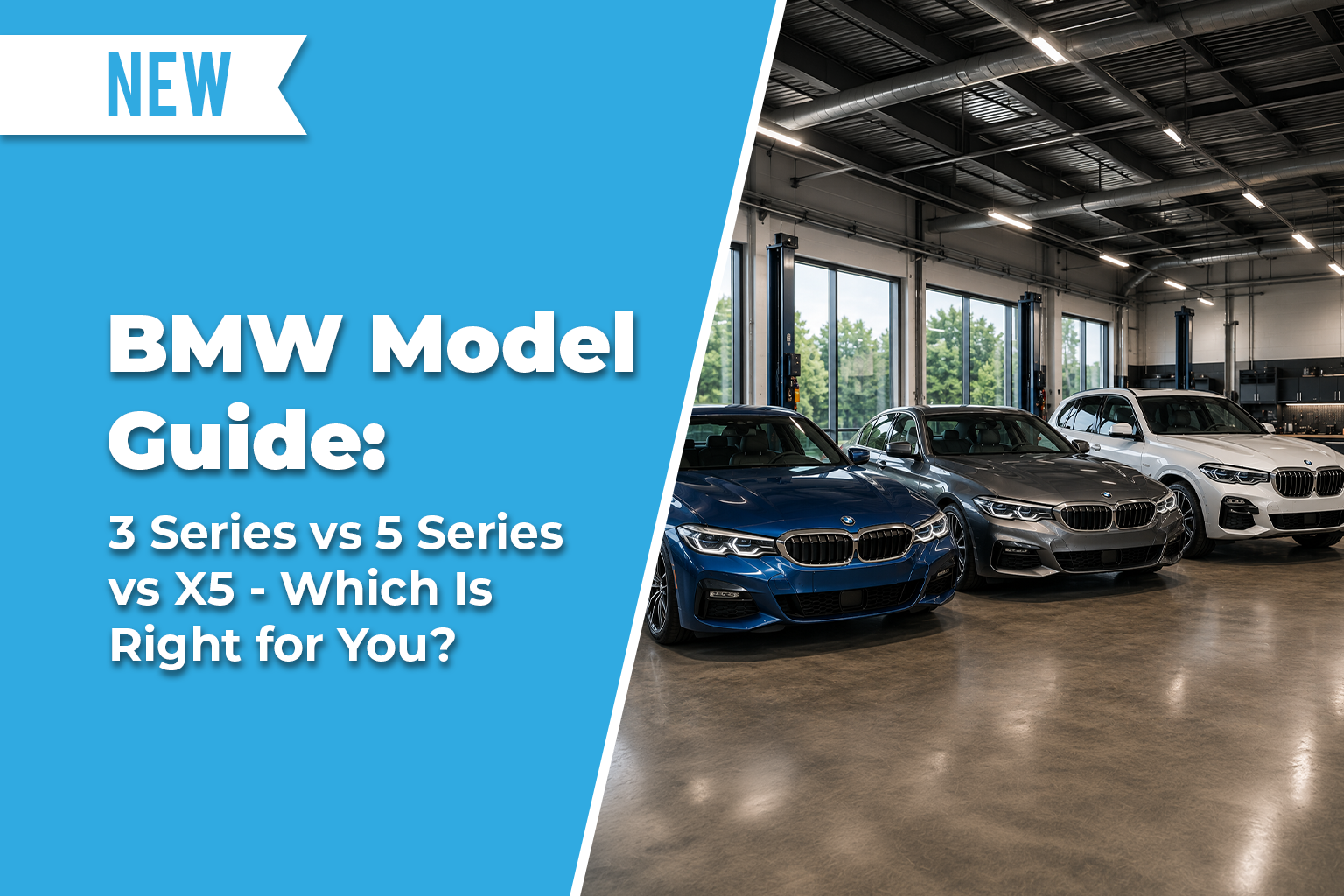
Choosing between the BMW 3 Series, 5 Series and X5 is not simply a question of how much you want to spend.
The three models are designed for very different types of drivers.
The 3 Series is the compact and sporty option. The 5 Series adds significantly more space, comfort and executive presence. The X5 provides the elevated seating position, cargo capacity and versatility many families expect from a large luxury SUV.
Buy the wrong one and you may end up paying for space you rarely use—or wishing you had chosen something larger every time the family goes away.
This guide compares the core BMW models by size, performance, practicality, pricing position and everyday use to help you decide which one fits your lifestyle.
BMW 3 Series vs 5 Series vs X5: The Quick Answer
Choose the BMW 3 Series when you want:
- The most agile driving experience
- A smaller car for urban roads and parking
- Strong performance without moving into a large luxury vehicle
- The lowest entry point of these three BMW ranges
- A sedan that works for commuting and occasional family use
Choose the BMW 5 Series when you want:
- More rear-seat space
- Better long-distance comfort
- A more premium executive-car experience
- A choice of petrol, diesel or fully electric power
- A sedan that feels substantial without moving to an SUV
Choose the BMW X5 when you want:
- A high driving position
- More flexible cargo space
- Easier access for children or passengers
- Petrol, diesel and plug-in hybrid choices
- A luxury family SUV for holidays, equipment and longer journeys
BMW Model Comparison at a Glance
| Feature |
BMW 3 Series Sedan |
BMW 5 Series Sedan |
BMW X5 |
| Body style |
Sports sedan |
Large executive sedan |
Large luxury SUV |
| Length |
4,713–4,714 mm |
5,060 mm |
4,935 mm |
| Width |
1,827 mm |
1,900 mm |
2,004 mm |
| Height |
1,440 mm |
1,505–1,515 mm |
1,765 mm |
| Luggage capacity |
480 litres |
490–520 litres |
650–1,870 litres |
| Current powertrain choices |
Petrol |
Petrol, diesel and electric |
Petrol, diesel and plug-in hybrid |
| Best suited to |
Urban driving and performance |
Comfort and long-distance travel |
Families, cargo and versatility |
| Relative purchase price |
Lowest of the three |
Mid-to-high |
Generally highest |
Specifications vary by model, drivetrain and optional equipment. The measurements above are based on current BMW Australia technical information.
BMW 3 Series: Best for Drivers Who Value Agility
The BMW 3 Series is usually the natural starting point for drivers who want a premium sedan with genuine performance credentials.
It is smaller, lighter and easier to position on the road than the 5 Series or X5. That makes it well suited to commuting, parking in tighter spaces and driving through busy urban areas.
The current BMW 330i Sedan produces 190kW and 400Nm, reaching 100km/h in a claimed 5.8 seconds. The more powerful M340i xDrive increases output to 285kW and adds all-wheel drive.
BMW 3 Series dimensions and practicality
The 3 Series measures approximately:
- 4,713 mm long
- 1,827 mm wide
- 1,440 mm high
- 2,851 mm between the axles
Its boot provides 480 litres of luggage capacity. That is enough for everyday shopping, work equipment or several travel bags, but it does not offer the same flexible load area as the X5.
What the 3 Series feels like to drive
The 3 Series is the most driver-focused option in this comparison.
Its lower seating position and more compact dimensions make it feel more responsive when changing direction. It is likely to appeal to drivers who see the journey as more than simply getting from one place to another.
The ride can feel firmer than the 5 Series, particularly on models fitted with larger wheels, low-profile tyres or sports suspension.
Who should buy a BMW 3 Series?
The 3 Series is a strong choice for:
- Professionals travelling alone or with one passenger
- Couples who do not regularly need SUV cargo capacity
- Drivers commuting into central Brisbane
- Buyers who prioritise handling over rear-seat space
- Small families who still prefer a sedan
- Drivers upgrading from a compact or medium-sized car
Reasons the 3 Series may not be right for you
Consider something larger when you regularly carry:
- Adults in the rear seats
- Child seats and prams
- Large sporting equipment
- Bulky work gear
- Luggage for extended family trips
The 3 Series can perform these jobs occasionally, but the 5 Series or X5 will do them more comfortably.
BMW 5 Series: Best for Space and Executive Comfort
The difference between the BMW 3 Series vs 5 Series is greater than many buyers expect.
The current 5 Series is 5,060 mm long—approximately 347 mm longer than the 330i—and has a wheelbase that is 144 mm longer. It is also wider and taller. The additional size benefits rear-seat passengers and contributes to a more substantial long-distance driving experience.
An interesting detail is that the current 5 Series sedan is actually longer than the X5. The SUV remains considerably wider and taller, but buyers should not assume the 5 Series will automatically be easier to park because it sits lower to the ground.
BMW 5 Series powertrain choices
The 5 Series provides more drivetrain variety than the current 3 Series range.
BMW Australia currently lists petrol and diesel combustion models, while the closely related BMW i5 provides fully electric alternatives. Current offerings include the 520i, the six-cylinder 540d xDrive and several i5 variants.
The 520i produces 140kW and 310Nm, reaching 100km/h in a claimed 8.1 seconds. It prioritises smoothness and efficiency rather than outright acceleration. The 540d xDrive offers 223kW of combined mild-hybrid output and 670Nm, making it better suited to drivers who want strong long-distance performance.
BMW 5 Series dimensions and luggage space
The 5 Series measures approximately:
- 5,060 mm long
- 1,900 mm wide
- 1,505–1,515 mm high
- 2,995 mm between the axles
Combustion-powered versions offer up to 520 litres of luggage capacity. Electric i5 versions generally provide 490 litres due to differences in the drivetrain and vehicle packaging.
The boot is only moderately larger than that of the 3 Series, but the 5 Series provides a more spacious passenger compartment and greater rear-seat comfort.
What the 5 Series feels like to drive
The 5 Series is more focused on refinement than the 3 Series.
It is designed to feel stable, quiet and composed on long journeys. It can still deliver strong performance, but it tends to isolate passengers from poor road surfaces more effectively than a sports-oriented 3 Series.
Its larger turning footprint and overall length are more noticeable in small car parks and narrow streets.
Who should buy a BMW 5 Series?
The 5 Series is well suited to:
- Drivers covering long motorway distances
- Business owners and executives
- Families wanting sedan comfort
- Buyers who regularly carry adult rear passengers
- Drivers considering an electric executive sedan
- Anyone who finds the 3 Series too compact but does not want an SUV
Reasons the 5 Series may not be right for you
Its extra comfort comes with greater size, weight and cost.
Compared with the 3 Series, owners may also face higher expenses for:
- Tyres
- Brakes
- Suspension components
- Insurance
- Registration and purchase-related charges
- More sophisticated optional equipment
The 5 Series offers more car, but you should make sure you will genuinely use the additional room and refinement.
BMW X5: Best for Families and Everyday Versatility
The BMW X5 vs sedan decision is primarily about how you use the vehicle.
The X5 is not simply a taller 5 Series. Its large rear opening, folding seats, raised driving position and more flexible luggage area make it a different type of vehicle.
BMW positions the X5 as a large luxury SUV for families, longer journeys and a combination of urban and recreational use. The Australian range includes petrol, diesel and plug-in hybrid powertrains.
BMW X5 dimensions and luggage space
The current X5 measures:
- 4,935 mm long
- 2,004 mm wide
- 1,765 mm high
Its luggage compartment holds approximately 650 litres with the rear seats in use and up to 1,870 litres when additional space is opened.
Although it is shorter than the 5 Series, it is 104 mm wider before accounting for mirrors. That width can be noticeable in shopping-centre car parks, older garages and narrow suburban streets.
BMW X5 performance
The X5 does not sacrifice performance simply because it is larger.
The current X5 xDrive40i produces 280kW and can reach 100km/h in a claimed 5.4 seconds. The X5 xDrive50e plug-in hybrid combines a petrol engine and electric motor for up to 360kW of total output. BMW quotes up to 101 km of electric-only range for the plug-in hybrid under the applicable test standard.
Actual electric range will vary according to charging, temperature, route, vehicle configuration and driving style.
Why families choose the X5
The X5 can make everyday family tasks easier because it provides:
- A higher seating position
- Easier access when fitting child seats
- A larger and more flexible cargo area
- Better space for prams and sporting equipment
- All-wheel-drive availability
- Greater ground clearance
- More flexibility for holidays and recreational trips
It is also likely to suit drivers travelling regularly between Sandgate, the Sunshine Coast and other areas where additional space is more important than compact city dimensions.
Reasons the X5 may not be right for you
The X5 will usually be the most expensive vehicle of these three to buy and operate.
Its size can contribute to higher costs for:
- Large-diameter tyres
- Brake components
- Wheel alignment
- Suspension repairs
- Fuel
- Insurance
- Registration
- Plug-in hybrid system maintenance where applicable
You may also find it unnecessarily large when most journeys involve one or two people and little luggage.
BMW 3 Series vs 5 Series: What Is the Real Difference?
The easiest way to understand the difference is to consider their priorities.
The 3 Series prioritises driving involvement. It is smaller, quicker to respond and easier to use in built-up areas.
The 5 Series prioritises passenger comfort. It offers more rear-seat room, stronger long-distance refinement and a broader range of drivetrain choices.
Choose the 3 Series when you usually drive alone and enjoy a more compact sports-sedan experience.
Choose the 5 Series when passengers, comfort and motorway travel matter more than outright agility.
BMW X5 vs Sedan: Do You Really Need an SUV?
An SUV is not automatically the better family vehicle.
A sedan may still be the smarter choice when:
- You rarely carry bulky items
- You prefer a lower driving position
- You want sharper handling
- You frequently park in narrow spaces
- You do not need a large tailgate opening
- You want to reduce tyre and fuel expenses
The X5 becomes more convincing when you regularly load prams, pets, luggage or sporting equipment—or when passengers find stepping down into a sedan uncomfortable.
Before deciding, load the vehicle the way you would use it. A test drive without your child seat, pram or everyday equipment may not reveal whether the car is genuinely practical.
Comparing BMW Pricing
Exact BMW pricing varies according to:
- Model and engine
- Optional packages
- Paint and interior choices
- State-based charges
- Dealer pricing
- Whether the vehicle is new, demonstrator or used
- Available finance or manufacturer offers
As a general buying hierarchy:
- BMW 3 Series: Lowest entry point and generally the most affordable to run
- BMW 5 Series: Higher purchase price in exchange for more space and luxury
- BMW X5: Generally the highest purchase and operating cost because of its size, drivetrain and equipment
Do not compare monthly finance repayments alone. A lower repayment may be achieved through a larger final payment, different loan term or deposit.
Compare the complete ownership cost, including:
- Purchase price
- Interest and finance fees
- Comprehensive insurance
- Scheduled servicing
- Tyres and brakes
- Fuel or charging
- Registration
- Expected depreciation
- Out-of-warranty repairs
Which BMW Offers the Best Performance?
There is no single winner because performance varies dramatically by engine and variant.
A standard 330i feels lighter and more agile than an X5, even when the SUV has more power.
A 540d may be the better long-distance performer because of its strong torque and stable road manners.
An X5 xDrive40i provides impressive acceleration, but its size and weight produce a different driving experience from a sports sedan.
The best comparison is not simply the quickest zero-to-100km/h time. Consider:
- Throttle response
- Steering feel
- Ride comfort
- Road noise
- Braking confidence
- Visibility
- Ease of parking
- How the car behaves on your normal roads
Which Is the Best BMW Model for Families?
For maximum practicality, the X5 is the strongest option.
Its larger luggage area and flexible rear compartment make it better suited to prams, holiday gear and active family use.
However, the 5 Series may be the best BMW model for a family that prefers a sedan. It offers considerably more passenger room than the 3 Series without the height and width of the X5.
The 3 Series remains suitable for smaller families, particularly when most journeys are short and luggage requirements are limited.
Which BMW Is Best for Driving Around Sandgate?
The right option depends on your usual journeys.
For Sandgate and inner Brisbane commuting
The 3 Series is likely to be easiest to park and manoeuvre. Its compact size is useful when navigating narrow streets or crowded car parks.
For Gateway Motorway and long-distance travel
The 5 Series provides a strong balance of comfort, stability and passenger space.
For family trips and recreational use
The X5 provides the most flexible luggage space and an elevated seating position.
Remember that the X5 is more than two metres wide without mirrors. Measure your garage and consider your regular parking locations before committing to a large SUV.
How to Test-Drive the BMW 3 Series, 5 Series and X5
BMW Australia’s stock and dealer system allows buyers to request test drives, although appointments depend on dealer confirmation and vehicle availability.
For a useful comparison, try to drive the shortlisted models on the same day and over similar roads.
During each test drive:
- Adjust the seat and mirrors properly.
- Check visibility at intersections.
- Drive over rough or patched roads.
- Test low-speed manoeuvring.
- Park the vehicle without relying only on cameras.
- Sit in the rear seats.
- Inspect the boot opening and floor height.
- Connect your phone.
- Listen for tyre and wind noise.
- Check that the ride remains comfortable after the initial excitement wears off.
Where possible, bring the passengers and equipment you regularly carry.
Buying a Used BMW 3 Series, 5 Series or X5
Buying used can significantly reduce the initial purchase price, but condition and maintenance history matter more than the badge.
Before purchasing, check:
- Complete service history
- Outstanding recalls
- Warning lights and stored fault codes
- Oil and coolant leaks
- Cooling-system condition
- Tyre wear
- Brake condition
- Suspension noises
- Battery health
- Infotainment and electrical functions
- Evidence of accident repairs
- Correct operation of driver-assistance systems
A pre-purchase inspection should include a complete diagnostic scan. Modern BMWs can store historical and pending faults even when no warning is currently visible.
The X5 deserves particular attention because large tyres, brakes, suspension components and complex drivetrains can make neglected maintenance expensive.
BMW Servicing in Sandgate
The cost of owning a BMW does not end when you leave the dealership.
Whichever model you choose, regular maintenance will help protect its reliability, performance and resale value.
At Sandgate Auto Electrics & Automotive Services, our team services and diagnoses European vehicles, including BMW models. Available services include scheduled servicing, computer diagnostics, electrical repairs, brake inspections, suspension repairs, air-conditioning work and pre-purchase inspections.
Our workshop is located at 101 Connaught Street, Sandgate, serving customers from Sandgate, Brighton, Deagon, Bracken Ridge, Shorncliffe and surrounding areas of Brisbane’s northside.
We do not sell BMW vehicles, so our comparison can focus on the practical ownership questions:
- Which model matches your everyday use?
- What maintenance should you expect?
- Are there signs of existing mechanical or electrical problems?
- Is a used vehicle worth the asking price?
- What repairs may be required after purchase?
Frequently Asked Questions
Is a BMW 5 Series much bigger than a 3 Series?
Yes. The current 5 Series is approximately 347 mm longer and 73 mm wider than the 330i. It also has a longer wheelbase, providing additional interior and rear-passenger space.
Is the BMW X5 longer than the 5 Series?
No. The current 5 Series sedan is approximately 5,060 mm long, while the X5 is approximately 4,935 mm long. The X5 is considerably wider and taller.
Which has more boot space: the BMW 5 Series or X5?
The X5. It offers approximately 650 litres with the rear seats being used and up to 1,870 litres when more cargo space is opened. The combustion-powered 5 Series sedan provides up to approximately 520 litres.
Is the BMW 3 Series suitable for a family?
Yes, particularly for a smaller family that does not frequently carry bulky equipment. Families using large child seats, prams and holiday luggage may find the 5 Series or X5 more practical.
Is the BMW 5 Series more comfortable than the 3 Series?
Generally, yes. The 5 Series is designed to provide more passenger space and long-distance refinement, while the 3 Series has a more compact, driver-focused character.
Is the BMW X5 expensive to maintain?
Maintenance expenses vary, but an X5 can cost more than a 3 Series because it uses larger tyres, brakes and suspension components. Its drivetrain and optional equipment may also be more complex.
Which BMW model is the easiest to park?
The 3 Series is the shortest and narrowest of the three, making it generally easier to position in tight parking spaces.
Should I buy a BMW sedan or SUV?
Choose a sedan when you value handling, efficiency and a lower seating position. Choose the X5 when cargo flexibility, easier access and an elevated driving position matter more.
Can I arrange a pre-purchase inspection before buying a BMW?
Yes. A pre-purchase inspection can identify mechanical, electrical and diagnostic concerns before you commit to the vehicle.
The Final Verdict
There is no single best BMW for every driver.
The BMW 3 Series is the best fit for buyers who want a compact, engaging sports sedan.
The BMW 5 Series is the better choice for drivers who value passenger space, refinement and long-distance comfort.
The BMW X5 is the most practical option for families, equipment and everyday SUV versatility.
The most expensive model is not automatically the right one. Choose the vehicle that fits the journeys you actually make—not the journeys you imagine making once or twice a year.
Compare BMW Models With Our Team
Considering a BMW 3 Series, 5 Series or X5?
Arrange your test drives through a BMW retailer, then speak with Sandgate Auto Electrics & Automotive Services about servicing requirements, expected ownership costs or a pre-purchase inspection.
Our team can help you assess the mechanical and electrical condition of a used BMW before you buy and recommend a servicing package suited to your chosen model.
Call (07) 3269 3158 or visit our workshop at 101 Connaught Street, Sandgate QLD 4017 to discuss your BMW.
Specifications, power outputs, luggage capacity, availability and pricing can vary according to model, drivetrain, optional equipment and production date. Confirm the exact Australian specification and drive-away price before purchasing.
Need assistance? Get in touch.
📞 Call us: (07) 3269 3158
📍 Visit us: 101 Connaught Street, Sandgate Qld 4017
📧 Email: [email protected]