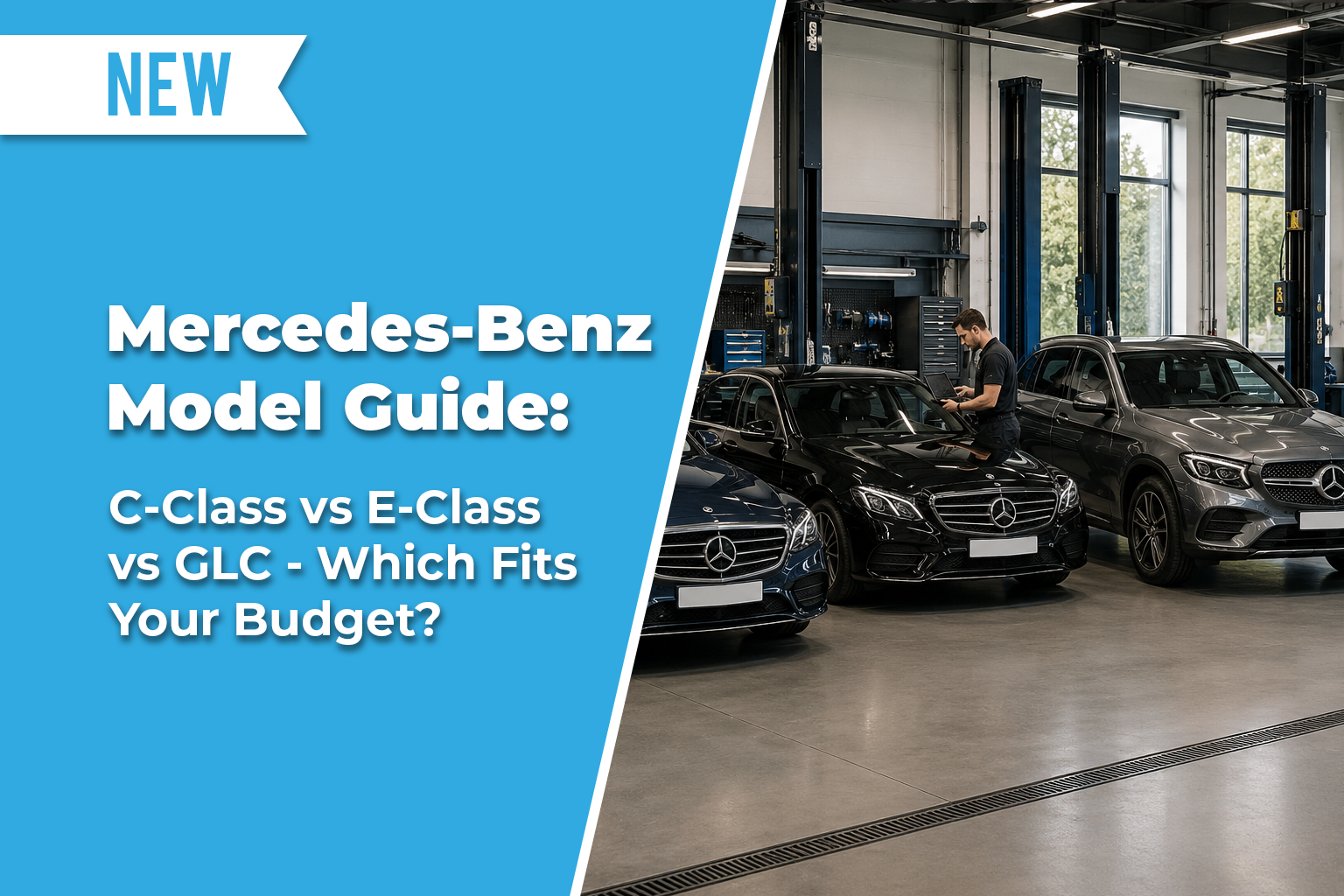
The most expensive Mercedes-Benz is not automatically the best one for you.
The C-Class, E-Class and GLC all provide a premium interior, advanced technology and strong brand appeal, but they solve very different problems.
The C-Class is the compact luxury sedan. It is easier to manoeuvre, more affordable to enter and well suited to commuting.
The E-Class is the larger executive sedan. It focuses more heavily on passenger comfort, advanced technology and long-distance refinement.
The GLC is the practical SUV. It provides a higher seating position, all-wheel drive and a much more flexible luggage area.
Choosing correctly is not only about the purchase price. The size of the vehicle, tyre costs, insurance, fuel use, servicing requirements and the way you use the car every day can make a major difference to your total ownership budget.
This guide compares the three core Mercedes models to help you decide which one fits your lifestyle and finances.
C-Class vs E-Class vs GLC: The Quick Answer
Choose the Mercedes-Benz C-Class when you want:
- The lowest-cost entry into this group
- A compact luxury sedan
- Easier parking and urban manoeuvrability
- A sporty, modern interior
- Petrol, mild-hybrid or plug-in hybrid choices
- Premium features without moving to a larger vehicle
Choose the Mercedes-Benz E-Class when you want:
- More passenger space
- Greater long-distance comfort
- A more advanced executive interior
- More sophisticated assistance and lighting technology
- A sedan with stronger road presence
- Luxury and refinement ahead of outright practicality
Choose the Mercedes-Benz GLC when you want:
- A higher seating position
- More cargo space
- Easier loading for family equipment
- Standard 4MATIC all-wheel drive
- Petrol or plug-in hybrid options
- SUV practicality without moving to a full-size model
Mercedes Model Comparison at a Glance
| Category |
Mercedes-Benz C-Class |
Mercedes-Benz E-Class |
Mercedes-Benz GLC |
| Body style |
Medium luxury sedan |
Large executive sedan |
Medium luxury SUV |
| Seating |
Five |
Five |
Five |
| Core priority |
Compact luxury |
Executive comfort |
Everyday versatility |
| Driving position |
Low |
Low |
Elevated |
| Powertrain choices |
Petrol mild hybrid and plug-in hybrid |
Petrol |
Petrol and plug-in hybrid |
| Luggage practicality |
Conventional sedan boot |
Larger executive-sedan boot |
Up to 620 litres |
| Drivetrain |
Primarily rear-wheel drive, depending on version |
Rear-wheel drive, depending on version |
4MATIC all-wheel drive |
| Relative budget |
Lowest starting point |
Higher luxury position |
Usually between or overlapping the sedans |
| Best suited to |
Commuting and couples |
Business and long-distance travel |
Families and active lifestyles |
Exact pricing, features and specifications depend on the version, optional equipment, postcode and current Mercedes-Benz offers. Mercedes-Benz Australia displays estimated drive-away pricing through its configurator and available-stock system.
Mercedes-Benz C-Class: Best for Compact Luxury
The C-Class is the most accessible model in this comparison.
It combines the traditional proportions of a Mercedes-Benz sedan with much of the technology and interior styling found in the brand’s larger vehicles.
For buyers comparing the Mercedes C-Class vs E-Class, the C-Class will usually be easier to drive around busy suburban streets, position in shopping-centre car parks and fit inside a smaller garage.
Current C-Class Powertrain Choices
Mercedes-Benz Australia currently lists the C 200 and C 300 with mild-hybrid petrol drivetrains. The C 200 produces 150kW plus assistance from a 17kW integrated electric system, while the C 300 produces 190kW plus the same 17kW electrical assistance.
The C 350 e adds a plug-in hybrid system combining a 150kW petrol engine with a 95kW electric motor. Mercedes-Benz quotes an NEDC-tested electric range of up to 104 kilometres, depending on conditions and vehicle configuration.
What Mild Hybrid Means
The mild-hybrid C 200 and C 300 cannot normally be driven as fully electric vehicles in the same way as the C 350 e.
Instead, the integrated electrical system assists the petrol engine during certain driving situations, supports smoother stop-start operation and can contribute additional power when required.
The plug-in hybrid C 350 e has a larger battery that can be charged externally and used for a more substantial amount of electric-only driving. Mercedes-Benz lists 11kW AC and up to 55kW DC charging capability for the current Australian model.
C-Class Interior and Features
The current C-Class includes AMG Line interior and exterior styling, ambient lighting, a head-up display and the Mercedes-Benz User Experience infotainment system on the specification promoted by Mercedes-Benz Australia.
Available or listed technology includes:
- Digital driver display
- Central touchscreen
- Smartphone integration
- Fingerprint scanner
- Head-up display
- Burmester surround sound
- Active Distance Assist DISTRONIC
- Lane-keeping assistance
- Traffic-sign assistance
- 360-degree camera
- Memory front seats
Features can vary between versions and model years, so buyers should confirm the exact vehicle specification rather than relying on the model badge alone.
What the C-Class Is Like to Own
The C-Class is likely to be the most manageable choice for drivers who spend most of their time around Sandgate, Brisbane’s northside and inner-city areas.
Its lower size and sedan body can make it easier to:
- Park in narrow spaces
- Fit inside an older garage
- Navigate congested roads
- Reduce unnecessary vehicle weight
- Avoid paying for unused passenger and cargo space
The trade-off is that rear-seat and luggage flexibility are more limited than in the GLC. The C-Class will accommodate a small family, but buyers regularly carrying prams, pets, sporting equipment or holiday luggage may find the SUV more convenient.
Who Should Buy a C-Class?
The C-Class is a strong fit for:
- Singles and couples
- Professionals commuting into Brisbane
- Buyers moving into a premium brand for the first time
- Small families that prefer a sedan
- Drivers who value styling and technology over maximum space
- Buyers with a tighter luxury-car budget
Reasons Not to Choose the C-Class
Consider the E-Class or GLC when:
- Adults regularly use the rear seats
- You want a softer, more isolated driving experience
- You carry bulky equipment
- You prefer an elevated seating position
- You regularly travel with children, luggage and a pram
- Executive presence is an important part of the purchase
Mercedes-Benz E-Class: Best for Executive Comfort
The E-Class sits above the C-Class in Mercedes-Benz’s sedan range.
It is designed for drivers who want more passenger space, a more substantial road presence and additional comfort and technology.
The current Australian E 200 uses a 2.0-litre four-cylinder petrol engine producing 150kW, paired with a nine-speed automatic transmission.
C-Class vs E-Class: What Is the Real Difference?
The biggest difference is not performance. It is the overall experience.
The C-Class is the more compact and youthful choice. The E-Class feels like a larger executive vehicle designed to make long journeys easier for both the driver and passengers.
Compared with the C-Class, the E-Class places greater emphasis on:
- Rear-passenger comfort
- Cabin isolation
- Advanced assistance systems
- Premium lighting
- Front-seat comfort
- Executive presentation
- Long-distance refinement
The E-Class is therefore more likely to suit business owners, senior professionals and drivers who regularly travel between Brisbane and regional areas.
E-Class Interior and Technology
Mercedes-Benz promotes the current E-Class with features including the MBUX Superscreen, Driving Assistance Package Plus and DIGITAL LIGHT.
Depending on the vehicle’s exact configuration, equipment may include:
- A separate front-passenger display
- Driver-monitoring camera
- Head-up display
- Climatised front seats
- Memory seat package
- Burmester surround sound
- 360-degree parking camera
- Laminated windscreen
- Advanced collision and lane assistance
The front-passenger display and expanded digital environment help distinguish the E-Class from the smaller C-Class.
What the E-Class Is Like to Own
The E-Class is better suited to longer journeys than tight urban environments.
Its larger body can provide a more comfortable and stable highway experience, but it will also require more consideration when parking or entering a narrow garage.
Potential ownership expenses may also be higher because an E-Class can use:
- Larger tyres
- More advanced electronic equipment
- More expensive lighting components
- Additional driver-assistance sensors
- Higher-value interior equipment
- More complex optional systems
A buyer who rarely uses the rear seats may find that much of the E-Class’s extra size and comfort goes unused.
Who Should Buy an E-Class?
The E-Class makes sense for:
- Executives and business owners
- Drivers covering long distances
- Buyers regularly carrying adult passengers
- Owners who value comfort more than compact dimensions
- Customers seeking a traditional luxury sedan
- Drivers who want more technology than the C-Class offers
Reasons Not to Choose the E-Class
The E-Class may be unnecessary when:
- Most journeys involve one person
- You rarely travel outside the local area
- Your garage or parking space is limited
- You need SUV-style cargo flexibility
- You are trying to minimise ownership costs
- The C-Class already provides all the space you need
Mercedes-Benz GLC: Best for SUV Practicality
The GLC serves a different type of buyer.
Rather than competing directly with the C-Class or E-Class as another sedan, it combines Mercedes-Benz luxury with a higher driving position, five-door body and more flexible luggage area.
Mercedes-Benz Australia lists the GLC with up to 620 litres of boot capacity. Current models also include 4MATIC all-wheel drive, an off-road driving mode and an MBUX off-road display.
GLC Powertrain Choices
The current GLC 200 4MATIC uses a 2.0-litre petrol engine producing 150kW and a nine-speed automatic transmission.
The GLC 350 e 4MATIC plug-in hybrid combines a 150kW petrol engine with a 115kW electric motor. Mercedes-Benz lists 11kW AC charging, up to 60kW DC charging and a 29-minute quoted charging time from 10% to 80% under the applicable test conditions.
Mercedes GLC vs Sedan: What Changes?
Choosing the Mercedes GLC vs sedan is less about badge hierarchy and more about body style.
The GLC offers:
- Easier access through a large tailgate
- More flexible luggage capacity
- A raised seating position
- Greater ground clearance
- Standard all-wheel drive
- Easier loading of bulky equipment
- Better versatility for family trips
The C-Class and E-Class offer:
- A lower centre of gravity
- More traditional sedan styling
- A more connected road feel
- Potentially easier access to low underground parking
- Less body movement through corners
- A conventional executive-car appearance
Neither layout is automatically better. The right one depends on how the vehicle will be used.
GLC Interior and Technology
The current GLC specification promoted in Australia includes heated memory seats, ambient lighting, a digital instrument cluster and head-up display.
Listed technology also includes:
- Smartphone integration
- Apple CarPlay and Android Auto
- Fingerprint sensor
- Burmester surround sound
- Active Steering Assist
- Lane-keeping assistance
- Driving Assistance Package Plus
- 360-degree camera
- HANDS-FREE ACCESS
- DIGITAL LIGHT
- Wireless phone charging
As with the sedans, exact equipment depends on the version and optional package.
Who Should Buy a GLC?
The GLC is likely to be the best Mercedes model for:
- Families carrying prams or sporting equipment
- Buyers who prefer an elevated driving position
- Drivers with limited mobility who find low sedans difficult to enter
- Owners travelling with pets
- Buyers wanting all-wheel drive
- Drivers combining suburban commuting with weekend trips
- Households that need one vehicle to perform several roles
Reasons Not to Choose the GLC
The GLC may not be necessary when:
- You rarely carry bulky luggage
- You prefer a lower driving position
- You value sharper sedan handling
- Your garage has limited width or height
- You want to minimise tyre and fuel expenses
- You do not need all-wheel drive
Which Mercedes Fits Your Budget?
Purchase price is only the first part of the calculation.
A practical budget comparison should consider the following.
C-Class: Lowest Entry Point
The C-Class generally provides the lowest purchase entry point among these three ranges.
In July 2026, Mercedes-Benz Australia’s C-Class page advertised a C 300 AMG Line Plus Edition at $94,900 drive-away. Campaign pricing can expire or change, so buyers should confirm the live price and inclusions before making a decision.
The C-Class may also cost less to operate because it is likely to use smaller tyres and less expensive consumable components than larger, higher-specification models.
GLC: Paying for Practicality
The GLC can overlap both sedan ranges depending on the selected drivetrain and equipment.
A petrol GLC may be relatively close to a highly specified C-Class, while a plug-in hybrid or AMG model can move into a substantially higher price bracket.
The additional money pays for:
- SUV body design
- All-wheel drive
- Increased luggage flexibility
- Higher seating position
- Larger wheels and tyres
- More complex drivetrain options
E-Class: Paying for Executive Luxury
The E-Class generally occupies the highest conventional luxury position of these three core models.
Buyers are paying for more than physical size. The extra cost reflects the model’s emphasis on passenger comfort, cabin refinement, advanced displays, lighting and assistance systems.
The E-Class may represent poor value when those features are not important to you. It can represent excellent value when long-distance comfort and executive presentation are central to the purchase.
Do Not Compare Finance Repayments Alone
A low advertised repayment does not necessarily mean the vehicle is cheaper.
Finance offers may differ in:
- Deposit amount
- Loan term
- Interest rate
- Fees
- Kilometre allowance
- Balloon or guaranteed future value
- Final payment
- Insurance requirements
Compare the total amount payable, not only the weekly or monthly figure.
Expected Ownership Costs
The C-Class will generally be the least expensive of these three to own, but the exact cost depends heavily on the selected version.
An AMG model or plug-in hybrid C-Class may cost more to maintain than a standard GLC or E-Class.
Consider the following before buying.
Tyres
Large wheels and low-profile tyres can be expensive.
Check:
- Front and rear tyre sizes
- Whether the vehicle uses staggered tyres
- Replacement cost per tyre
- Run-flat or mobility-system requirements
- Availability of the correct load and speed rating
The GLC may have particularly high tyre costs because of its SUV weight, all-wheel-drive system and wider wheel options.
Brakes
Vehicle weight, driving style and wheel size can all influence brake wear.
Plug-in hybrids are heavier than equivalent petrol models, although regenerative braking can reduce the use of conventional brakes in some conditions.
Electronics
All three vehicles contain interconnected cameras, sensors, displays and control modules.
Repairs involving the following can be expensive:
- Digital headlights
- Radar sensors
- Parking cameras
- Infotainment screens
- Seat-control modules
- Driver-assistance systems
- Electronic suspension equipment
- Plug-in hybrid charging systems
Insurance
Insurance premiums may change considerably between a C 200, E 200, GLC 350 e and an AMG model.
Obtain an insurance quote for the exact registration or vehicle specification before agreeing to purchase.
Which Mercedes Is Best for Sandgate Drivers?
The right choice depends on the roads, passengers and equipment involved in your normal week.
Q. Best for Local Commuting: C-Class
For regular driving around Sandgate, Brighton, Deagon and Brisbane, the C-Class provides the most manageable dimensions and the lowest likely ownership burden.
It is particularly suitable when most journeys involve one or two occupants.
Q. Best for Gateway Motorway Travel: E-Class
The E-Class is the stronger choice when the vehicle regularly covers long distances and passenger comfort matters.
Its executive cabin and assistance technology are more valuable on extended journeys than during short local trips.
Q. Best for Family and Weekend Use: GLC
The GLC offers the most flexible layout for families travelling with prams, sporting gear, pets or luggage.
It is likely to suit buyers who want one vehicle for school runs, commuting and longer weekend travel.
Should You Buy a Sedan or SUV?
Do not choose the GLC simply because SUVs are popular.
Choose the SUV when its body style solves a genuine practical problem.
The GLC is likely to be worth the additional cost when you regularly need:
- A large tailgate
- Greater load height
- Easier passenger access
- All-wheel drive
- Flexible rear seating
- Additional luggage space
A C-Class or E-Class sedan may be the smarter purchase when you value:
- Lower driving position
- Sedan handling
- Easier parking
- Traditional executive styling
- Potentially lower running costs
- A quieter luggage compartment separated from the cabin
Buying a Used C-Class, E-Class or GLC
A used Mercedes-Benz should be assessed by condition and history—not by badge alone.
Before purchasing, check:
- Complete service history
- Warning lights
- Stored diagnostic faults
- Battery condition
- Tyre wear
- Brake condition
- Suspension noises
- Oil and coolant leaks
- Air-conditioning performance
- Infotainment operation
- Cameras and driver-assistance systems
- Evidence of previous accident repairs
- Plug-in hybrid charging operation where applicable
A diagnostic scan is particularly important because some electronic faults may be stored without an active dashboard warning.
Extra Checks for a Plug-In Hybrid
When inspecting a C 350 e or GLC 350 e, confirm:
- The charging cable is included
- The charging port locks and releases correctly
- The vehicle accepts AC charging
- No high-voltage warnings are present
- The petrol engine starts smoothly
- The cooling system is operating correctly
- The displayed electric range is reasonable for the conditions
- The battery warranty and service history are documented
Modern Mercedes-Benz vehicles depend on mechanical, electrical and software systems working together.
At Sandgate Auto Electrics & Automotive Services, our qualified technicians provide servicing and diagnostic support for Australian, Japanese and European vehicles.
Our workshop uses modern equipment to diagnose systems controlling the engine, transmission, brakes, lighting, dashboard, windows and air conditioning. Available servicing can be tailored to the vehicle, with inspections covering areas such as brakes, steering, suspension, tyres, fluids, lights and battery condition.
We are located at 101 Connaught Street, Sandgate QLD 4017, serving Mercedes-Benz owners across Sandgate, Brighton, Deagon, Shorncliffe, Bracken Ridge and Brisbane’s northside.
Frequently Asked Questions
Q. Is the Mercedes C-Class smaller than the E-Class?
Yes. The C-Class is positioned as the more compact luxury sedan, while the E-Class provides a larger executive-car experience with more emphasis on passenger comfort and advanced technology.
Q. Which is more practical: the C-Class or GLC?
The GLC is more practical for bulky luggage because it has a large tailgate, folding rear seats and up to 620 litres of load capacity. The C-Class is easier to manoeuvre and may be better for commuting.
Q. Is the GLC more expensive than the C-Class?
It usually occupies a higher price position than the entry-level C-Class, although pricing overlaps depending on the engine, trim and current offers. Compare the actual drive-away price of the exact vehicles you are considering.
Q. Is the E-Class more luxurious than the C-Class?
The E-Class places greater emphasis on executive comfort and advanced technology. Current features promoted by Mercedes-Benz include the MBUX Superscreen, DIGITAL LIGHT, climatised seats and Driving Assistance Package Plus.
Q. Which Mercedes is best for a family?
The GLC is generally the most practical choice because of its elevated seating position and flexible luggage area. A family that prefers sedan handling and does not carry bulky equipment may prefer the E-Class.
Q. Is the C-Class available as a plug-in hybrid?
Yes. Mercedes-Benz Australia currently lists the C 350 e plug-in hybrid alongside the mild-hybrid C 200 and C 300.
Q. Is the GLC all-wheel drive?
The current petrol and plug-in hybrid GLC versions displayed by Mercedes-Benz Australia use the 4MATIC all-wheel-drive system.
Q. Which Mercedes is cheapest to maintain?
A standard C-Class will generally have the lowest likely operating cost, but the exact result depends on the drivetrain, wheel size, optional equipment, vehicle condition and driving habits.
Q. Should I arrange a pre-purchase inspection?
Yes. A pre-purchase inspection can identify mechanical, electrical and diagnostic concerns before you commit to the vehicle.
Final Verdict: Which Is the Best Mercedes Model?
There is no single best Mercedes model for every buyer.
The C-Class is the best all-round choice for buyers who want compact luxury, modern technology and a more manageable ownership budget.
The E-Class is the best option for executive comfort, passenger space and long-distance refinement.
The GLC is the best choice for families and drivers who need SUV practicality, all-wheel drive and flexible luggage capacity.
Your decision should be based on the journeys you make every week—not the rare trip you might take once a year.
Compare Mercedes Models With Our Guide
Considering a Mercedes-Benz C-Class, E-Class or GLC?
Arrange test drives through a Mercedes-Benz retailer, then speak with Sandgate Auto Electrics & Automotive Services about servicing requirements, expected maintenance or a pre-purchase inspection.
Our team can inspect the mechanical and electrical condition of a used Mercedes-Benz and help you understand the likely ownership requirements before you buy.
Need assistance? Get in touch with the team.
Request a Quote Online