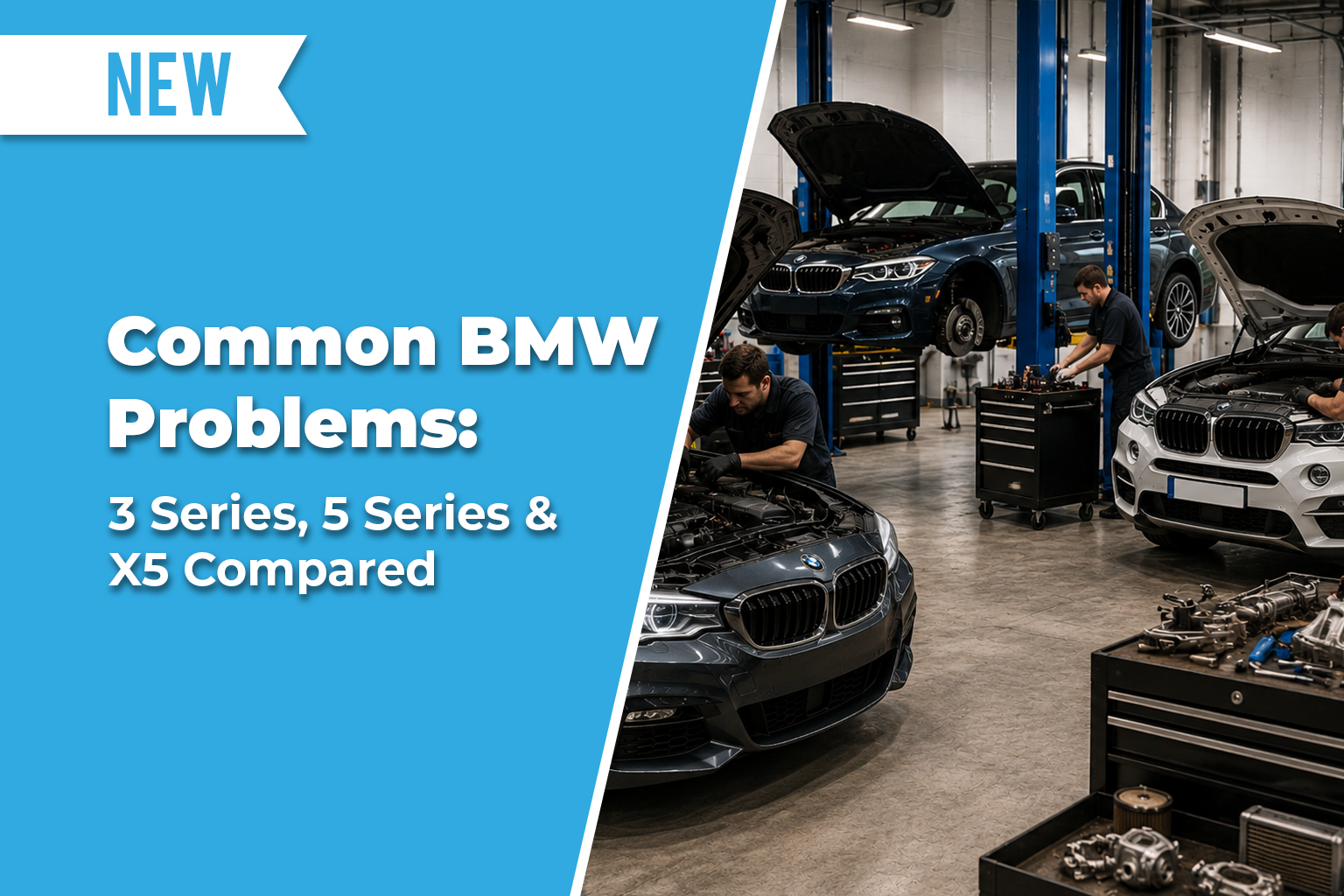
BMWs are built to make complicated engineering feel effortless.
That is why the first sign of trouble can be confusing.
A 3 Series may develop an engine whine, rattle or drivetrain warning that points toward its timing or VANOS system. A 5 Series may display several electrical warnings when the real problem is one weak battery or a module that refuses to shut down. An X5 may sit lower on one corner after being parked, but the fault could involve an air spring, height sensor, airline, compressor or control system.
Even the phrase BMW common problems can be misleading. BMW has produced numerous engines, transmissions and electronic architectures across the 3 Series, 5 Series and X5 ranges.
A fault associated with one engine or production period does not automatically apply to every vehicle carrying the same model badge.
This guide explains the major problems owners should know about, the symptoms that justify an inspection and why proper BMW diagnostics should come before expensive parts replacement.
Common BMW Problems at a Glance
| Model |
Commonly investigated areas |
Warning signs |
| BMW 3 Series |
Timing-chain and guide wear on selected engines, VANOS faults, N54 fuel and turbo issues |
Engine whine or rattle, reduced power, misfires, engine warning |
| BMW 5 Series |
Battery discharge, parasitic electrical drain, wiring and control-module faults |
Multiple warnings, dead battery, iDrive problems, intermittent no-start |
| BMW X5 |
Air-suspension leaks, ride-height sensor faults, compressor problems |
Vehicle leaning, rear suspension dropping, chassis warning, harsh ride |
These issues do not affect every BMW. Risk depends on the exact engine, production date, drivetrain, equipment, maintenance history and previous repairs.
Common BMW 3 Series Problems
The 3 Series has been produced with four-cylinder, six-cylinder, petrol, diesel, hybrid and high-performance engines.
Because of that variety, BMW 3 Series reliability cannot be judged from the model name alone.
Two areas that deserve particular attention on selected older models are the timing-chain system and BMW’s VANOS variable camshaft timing system.
1. Timing-Chain and Guide Wear on Selected N20 and N26 Engines
Certain F30-generation BMW 320i and 328i models were fitted with the turbocharged four-cylinder N20 or N26 engine.
BMW North America previously issued a component-specific warranty extension covering timing-chain and oil-pump drive-chain components on selected N20- and N26-powered vehicles. The listed vehicles included certain F30 320i and 328i variants produced during specific periods between 2011 and February 2015. The covered components included the timing chain, tensioner, guide rail, slide rail and sprocket.
That overseas warranty extension does not automatically apply to Australian vehicles. It does, however, identify the engine family and components that deserve attention when an affected vehicle develops suspicious symptoms.
Timing-Chain Warning Signs
Possible symptoms include:
- High-pitched whining that changes with engine speed
- Rattling from the engine
- Check-engine or drivetrain warning
- Rough running
- Extended cranking
- Reduced engine performance
- Camshaft and crankshaft timing faults
- Plastic guide material or metal debris in the engine oil
- Low oil-pressure warnings in a serious failure
BMW’s technical information described a whining noise from the lower engine area that increased in frequency as engine speed increased. The repair procedure for confirmed cases involved the oil-pump chain module and timing-chain components rather than replacing only one guide.
Why Timing-Chain Problems Become Expensive
The chain must keep the crankshaft and camshafts correctly synchronised.
If a guide breaks or the chain becomes excessively loose, valve timing can move outside its intended position. In a severe case, this can lead to internal engine contact and extensive damage.
Not every startup noise proves that the timing chain is failing. Similar noises may come from:
- Accessory-drive components
- Oil-pressure problems
- VANOS components
- The turbocharger or wastegate
- A loose heat shield
- Another chain-driven component
The noise, stored fault codes, engine data and oil condition should be assessed together.
Soft close: Hearing a new whine or rattle from your BMW? An early inspection is usually far less expensive than waiting for the warning light—or the engine—to make the decision for you.
2. BMW VANOS Problems
VANOS is BMW’s variable camshaft timing system.
It adjusts camshaft timing to improve performance, efficiency and low-speed response. Depending on the engine, a VANOS problem may involve solenoids, oil supply, adjustment units, sensors or their internal fasteners.
Common VANOS Symptoms
Possible symptoms include:
- Reduced engine power
- Drivetrain malfunction message
- Rough idle
- Hesitation
- Poor acceleration
- Increased fuel consumption
- Difficult starting
- Engine timing fault codes
- Engine stalling or failing to restart
A United States safety recall covered selected 2010–2013 BMW vehicles—including certain E90, E91, E92 and E93 3 Series models—because bolts inside the VANOS adjustment units could loosen and eventually break. BMW stated that an affected vehicle could enter reduced-power mode, fail to restart or, in rare cases, stall. The campaign applied only to specified engines and VINs.
Australian owners should check their registration or VIN through BMW Australia’s official recall-status tool rather than assuming an overseas campaign applies to their vehicle.
A VANOS Fault Does Not Always Mean a Failed Adjustment Unit
Camshaft timing codes may also be caused by:
- Low or contaminated engine oil
- Incorrect oil specification
- Restricted oil passages
- Faulty VANOS solenoids
- Camshaft-position sensors
- Crankshaft-position sensors
- Timing-chain wear
- Wiring or connector faults
- Incorrect mechanical timing
Replacing an adjustment unit without checking the oil supply and mechanical timing can leave the original problem unresolved.
3. Common BMW N54 Problems
The twin-turbocharged N54 engine is particularly well known among BMW enthusiasts.
It powered selected models including the E90, E92 and E93 335i, as well as certain 135i and 535i vehicles. It can deliver strong performance, but prospective buyers should understand the areas that have historically required attention.
High-Pressure Fuel Pump Problems
BMW issued an extended US warranty for high-pressure fuel pumps fitted to selected 2007–2010 N54 vehicles. BMW’s diagnostic procedure emphasised testing fuel pressure before replacing the pump because inaccurate measurements could lead to an incorrect diagnosis.
Possible symptoms include:
- Extended cranking
- Difficult cold or warm starting
- Reduced-power mode
- Engine warning light
- Hesitation under acceleration
- Fuel-pressure fault codes
- Engine stalling
These symptoms can also result from a low-pressure fuel pump, sensor, injector, wiring or control problem.
Fuel-Injector Problems
Selected early N54 vehicles were also subject to a US emissions recall involving injectors that could cause misfires and erratic engine operation. BMW technical information described cold-start rough running and cylinder-specific misfire faults associated with high-pressure injector problems.
Possible signs include:
- Rough cold start
- Fuel smell
- Black exhaust smoke
- Wet or fuel-fouled spark plugs
- Misfires
- Poor fuel economy
- Difficult starting
An injector should be confirmed as the cause before replacement. Spark plugs, ignition coils, compression and fuel pressure can produce overlapping symptoms.
Turbo Wastegate Rattle
Some early N54-powered 335i and 535i models developed a clanking or rattling noise around the turbocharger wastegate area.
BMW’s technical procedure varied according to production date and included software checks and actuator diagnosis before parts replacement. For applicable vehicles, BMW instructed technicians not to immediately replace the complete turbochargers based only on the noise.
This distinction matters because a wastegate actuator problem, boost leak and worn turbocharger are not the same repair.
Other N54 Areas to Inspect
A detailed N54 assessment may also include:
- Electric water pump and thermostat
- Valve-cover and oil-filter-housing leaks
- Charge pipes and intake hoses
- Ignition coils and spark plugs
- Crankcase ventilation
- Carbon deposits on intake valves
- Vacuum lines
- Boost-pressure control
The N54 can be an enjoyable engine when properly maintained, but buying one without a diagnostic and mechanical inspection can expose the new owner to several overdue repairs at once.
Common BMW 5 Series Problems
The 5 Series contains more comfort, infotainment and electronic equipment than many 3 Series models.
Depending on the generation, it may have electronically controlled seats, adaptive lighting, powered boot functions, multiple driver-assistance systems, advanced climate control and numerous interconnected modules.
That complexity is why BMW 5 Series electrical issues can appear as several unrelated warnings.
1. Battery Discharge and Parasitic Electrical Drain
A BMW battery can become discharged because the battery itself has failed—but it can also be the victim of another problem.
BMW’s technical guidance for discharged-battery complaints states that increased electrical demand makes a full energy diagnosis important. It also notes that a discharged battery often results from another component causing the drain, meaning battery replacement alone may not provide a permanent repair.
Symptoms of a Battery or Energy-Management Problem
Owners may notice:
- Slow cranking
- Intermittent no-start
- “Increased battery discharge” warning
- Clock or date resetting
- Comfort-access functions becoming unavailable
- Start-stop system disabled
- iDrive restarting
- Multiple warnings appearing together
- Battery repeatedly going flat after parking
- Interior lights or electronics behaving inconsistently
Possible causes include:
- Old or damaged battery
- Charging-system fault
- Control module remaining awake
- Faulty door, boot or bonnet switch
- Aftermarket dash camera or tracking device
- Comfort-access fault
- Water intrusion affecting electrical equipment
- Incorrect battery replacement
- Battery not being registered to the vehicle
- Frequent short journeys
Why BMW Battery Registration Matters
Many BMWs use an intelligent battery-management system.
When a new battery is installed, the vehicle may need to be informed that the battery has been replaced. The replacement battery must also match the required technology and capacity.
Battery registration is different from finding the reason the old battery discharged.
A correct repair may require:
- Testing the existing battery
- Testing charging output
- Reading the vehicle’s energy history
- Checking sleep current
- Identifying modules that remain awake
- Repairing the underlying cause
- Installing the correct replacement battery
- Registering the battery where required
2. Multiple Electrical Warnings
A 5 Series may display warnings for several systems when one shared fault affects the vehicle network.
Examples can include:
- Restraint-system warning
- Parking-brake fault
- Lighting fault
- Driver-assistance unavailable
- Steering or chassis warning
- Climate-control failure
- Infotainment interruption
- Camera or parking-sensor failure
Possible root causes include low voltage, damaged wiring, water intrusion, software errors or one failed module interrupting communication.
A complete vehicle scan is more useful than reading only the engine computer.
3. Newer 5 Series Wiring Campaigns
Electrical concerns are not limited to older vehicles.
In the United States, a 2026 recall covered certain G60 5 Series and i5 vehicles because an air-conditioning wiring harness could be damaged near the cabin-filter housing during servicing. In an extreme case, the damaged wiring could short-circuit and create a fire risk. The campaign covered specific production dates and US-market vehicles.
This does not establish that an Australian 5 Series is affected. It demonstrates why unusual electrical faults after recent work—and VIN-specific recall checks—should not be ignored.
Australian BMW owners can check for outstanding safety recalls or technical campaigns using BMW Australia’s recall tool.
4. iDrive and Infotainment Problems
Possible complaints include:
- Screen repeatedly rebooting
- Blank display
- Bluetooth disconnections
- No audio
- Navigation not loading
- Reversing camera unavailable
- Controller or touchscreen not responding
- Connected services becoming unavailable
The screen itself may not be the failed component.
An infotainment problem can originate from:
- Low system voltage
- Software
- Head unit
- Amplifier
- Communication network
- Wiring or connector
- Water intrusion
- Another module pulling down the network
Replacing the visible screen without testing the rest of the system can become an expensive guess.
Soft close: If your 5 Series repeatedly drains its battery or displays several warnings at once, book an electrical assessment before replacing more components. One underlying voltage or communication fault can create many symptoms.
Common BMW X5 Problems
The X5 combines a heavy SUV body with sophisticated suspension, xDrive, turbocharged engines and extensive electronics.
One of the more recognisable complaints on suitably equipped vehicles is an air-suspension fault.
Not every X5 has the same suspension system. Equipment varies by generation, version and optional package, so the vehicle must be identified correctly before parts are ordered.
1. BMW X5 Air-Suspension Problems
An air-suspension system uses pressurised air to support or adjust the vehicle’s ride height.
Depending on the version, it may include:
- Air springs or air struts
- Compressor
- Air reservoir
- Valve block
- Air lines
- Ride-height sensors
- Control module
- Relays and fuses
A fault in any one of these areas can produce similar symptoms.
Common X5 Air-Suspension Symptoms
Watch for:
- Rear of the vehicle sitting low
- One corner lower than the others
- Vehicle dropping overnight
- Compressor running frequently
- Compressor running for an unusually long time
- Chassis-stabilisation warning
- “Driving comfort restricted” message
- Ride height failing to adjust
- Harsh or bouncy ride
- Uneven tyre wear
BMW documented a G05 X5 concern where a “Driving comfort restricted” or chassis-stabilisation warning could be triggered by a disconnected ride-height sensor linkage. The diagnostic procedure involved checking the corresponding sensor linkage rather than immediately replacing air springs or the compressor.
That is an important example of why an air-suspension warning does not automatically prove the compressor has failed.
2. Vehicle Drops After Being Parked
When the vehicle is level when parked but lower several hours later, an air leak is one possible cause.
BMW diagnostic information describes suspension complaints where a vehicle’s ride height drops overnight or after being parked for an extended period. Some vehicles store a fault code, while others may show no obvious electronic cause.
Possible leak points include:
- Air spring
- Air-strut seal
- Airline connection
- Valve block
- Reservoir connection
- Compressor assembly
Temperature changes can also affect air pressure, so accurate leak testing should be performed under controlled conditions where possible.
3. Compressor Failure May Be a Secondary Problem
A leaking air spring can force the compressor to run repeatedly to restore ride height.
Over time, that extra workload can overheat or wear the compressor. Replacing the compressor without repairing the leak can result in the new unit being overworked as well.
A proper inspection may include:
- Full vehicle scan
- Ride-height measurements
- Leak testing
- Compressor-output test
- Inspection of air lines and connections
- Sensor-linkage inspection
- Fuse and relay testing
- Checking the valve block
- Verifying battery voltage
4. Suspension Noise That Is Not an Air Leak
Knocking, creaking or looseness may come from conventional suspension components rather than the air system.
Possible causes include:
- Control-arm bushes
- Ball joints
- Strut mounts
- Sway-bar links
- Wheel bearings
- Steering components
- Shock absorbers
- Tyres or wheel alignment
An X5 can therefore have a suspension noise without losing ride height, or lose ride height without producing a mechanical knock.
5. XDrive Shudder and Tyre Mismatch
Some X5 owners also experience vibration or shudder during low-speed turning or acceleration.
Potential causes include:
- Mismatched tyre sizes
- Significant tread-depth differences
- Incorrect tyre pressures
- Transfer-case fluid or adaptation issues
- Driveline mounts
- Propeller-shaft or joint wear
- Wheel or tyre damage
All four tyres should be compatible in size and rolling circumference because the xDrive system continuously manages torque between the axles.
Which BMW Is Most Reliable?
There is no reliable answer based only on the model badge.
A well-maintained 3 Series with complete records may be a far better purchase than a neglected X5 with unresolved warning lights. A properly serviced 5 Series may be dependable, while one with repeated battery discharge and water-damaged modules can become expensive.
The most important factors are:
- Engine and drivetrain
- Model year
- Service history
- Frequency of oil changes
- Quality of previous repairs
- Software and recall status
- Whether warning lights were diagnosed correctly
- Current mechanical and electrical condition
Why BMW Diagnostics Require More Than a Basic Code Reader
A basic scanner may identify a fault code, but it may not reveal the root cause.
For example:
- A camshaft code may come from VANOS, oil pressure, a sensor or timing-chain wear.
- A battery warning may come from the battery, alternator or a sleeping-current fault.
- An air-suspension warning may come from a leak, sensor linkage, compressor or low voltage.
- A turbo code may come from the turbocharger, wastegate, vacuum supply or a leaking intake hose.
A proper BMW diagnostic process may include:
- Confirming the owner’s description of the problem
- Identifying the exact engine and vehicle specification
- Scanning all control modules
- Recording active, pending and stored faults
- Testing the battery and charging system
- Reviewing live sensor data
- Checking oil condition and service history
- Inspecting wiring and connectors
- Performing mechanical, pressure or leak tests
- Road-testing under the conditions that trigger the fault
- Retesting after the repair
Clearing a fault code without correcting the cause only removes the warning temporarily.
Buying a Used BMW 3 Series, 5 Series or X5
A pre-purchase inspection should go beyond checking whether the engine light is currently on.
Check the Service History
Look for evidence of:
- Regular engine-oil changes
- Correct oil specification
- Cooling-system repairs
- Battery replacement and registration
- Gearbox or driveline servicing
- Timing-system work where relevant
- Suspension repairs
- Software campaigns
- Recall completion
BMW Australia advises that dealer-recorded service history may be available through the My BMW App, the vehicle’s iDrive service menu or an authorised BMW dealer using the VIN. Older vehicles may also use a physical service booklet.
Independent workshop invoices should also be retained, as they may not appear automatically in BMW’s digital record.
Start the Vehicle From Cold
A cold start may reveal:
- Timing-chain noise
- VANOS-related rough running
- N54 injector misfires
- Slow cranking
- Smoke
- Cooling-system warnings
A warm engine can temporarily hide symptoms that occur only during the first start of the day.
Scan Every Module
Fault codes may have been cleared before the sale.
A complete scan can identify:
- Pending engine faults
- Battery and energy-management history
- Suspension faults
- Communication errors
- Infotainment faults
- Previously triggered warnings
Test Every Electrical Feature
Check:
- iDrive
- Cameras
- Parking sensors
- Electric seats
- Climate control
- Central locking
- Comfort access
- Windows and mirrors
- Powered tailgate
- Driver-assistance systems
- Suspension-height controls where fitted
Luxury equipment can become expensive when several small faults are discovered after purchase.
Inspect the X5 After It Has Been Parked
Where possible, view an air-suspension-equipped X5 after it has remained parked for several hours.
A vehicle that leans or sits low may have an air leak even when it raises itself after startup.
When Should You Stop Driving?
Stop driving and arrange professional assistance when your BMW has:
- Red oil-pressure warning
- Severe overheating
- Loud timing-chain rattle
- Flashing engine light with heavy misfiring
- Engine repeatedly stalling
- Smoke or a burning electrical smell
- Major coolant or oil leak
- Vehicle sitting dangerously low on its suspension
- Steering or brake warning displayed in red
- Severe loss of power
- Charging warning followed by multiple electrical failures
Continuing to drive may turn a manageable repair into major engine, electrical or suspension damage.
BMW Diagnostics in Sandgate
BMW problems often involve several systems working together.
A 3 Series timing fault may involve the chain, VANOS system, oil pressure or a sensor.
A 5 Series battery warning may be caused by a module that remains awake rather than the battery itself.
An X5 suspension warning may come from a disconnected height sensor instead of a failed air spring.
At Sandgate Auto Electrics & Automotive Services, our technicians use professional diagnostic equipment to investigate BMW engine-management, electrical and electronic faults rather than simply clearing warning codes. The workshop services European vehicles, including BMW, and provides both mechanical and auto-electrical support.
A model-specific BMW assessment can help determine:
- Which faults are currently active
- Whether several warnings share one cause
- Whether timing-chain testing is appropriate
- Whether a VANOS code is electrical, hydraulic or mechanical
- Why the battery keeps discharging
- Whether the X5 air suspension has a leak or sensor problem
- Which repairs should be prioritised
Our workshop is located at 101 Connaught Street, Sandgate QLD 4017, serving BMW owners from Sandgate, Brighton, Deagon, Shorncliffe, Bracken Ridge and surrounding areas of Brisbane’s northside.
Frequently Asked Questions
Q. What are the most common BMW problems?
Commonly investigated areas include cooling-system leaks, oil leaks, battery discharge, electrical warnings, timing and VANOS faults, turbocharger issues and suspension wear. The actual risks depend on the engine, model and year.
Q. Do all BMW 3 Series have timing-chain problems?
No. The timing-chain concern discussed in this guide relates particularly to selected N20- and N26-powered vehicles. Other 3 Series engines use different components and have different fault patterns.
Q. Which BMW 3 Series engines were associated with timing-chain concerns?
BMW North America’s previous warranty extension listed selected F30 320i and 328i variants with N20 or N26 engines produced during specified periods. Australian coverage and vehicle eligibility must be checked separately.
Q. What does a failing BMW timing chain sound like?
Possible sounds include whining or rattling that changes with engine speed. However, accessory components, VANOS parts and turbocharger components can create similar noises.
Q. What are the symptoms of a BMW VANOS problem?
Symptoms may include rough idle, hesitation, reduced power, difficult starting, engine timing codes and a drivetrain-malfunction warning.
Q. Is the BMW N54 engine unreliable?
The N54 can perform well when properly maintained, but buyers should check its fuel system, injectors, turbo wastegates, cooling system, oil leaks and service history before purchasing.
Q. Why does my BMW 5 Series battery keep going flat?
Possible causes include a worn battery, charging fault, module that does not enter sleep mode, aftermarket accessories, water intrusion or frequent short trips. Energy diagnosis is needed to identify the cause.
Q. Can a weak BMW battery cause several warning lights?
Yes. Low voltage can stop control modules from starting or communicating correctly, producing several warnings from one underlying power-supply issue.
Q. Why is my BMW X5 sitting low at the rear?
Possible causes include leaking air springs, air lines, valve block, compressor issues or ride-height sensor faults. Not every X5 is equipped with air suspension.
Q. Does an air-suspension warning mean the compressor has failed?
No. BMW has documented X5 warnings caused by disconnected ride-height sensor linkage. The system should be tested before the compressor is replaced.
Q. Should I check my BMW for recalls?
Yes. BMW Australia provides an official tool that allows owners to check outstanding safety recalls or technical campaigns using the VIN or registration details.
Q. Should I arrange a pre-purchase inspection for a used BMW?
Yes. A mechanical inspection and complete diagnostic scan can uncover engine, electrical, suspension and communication faults before you commit to the vehicle.
Book a Diagnostic for Your BMW
A BMW warning message tells you that the vehicle has detected a problem.
It does not tell you which part to replace.
Whether your 3 Series has developed an engine rattle, your 5 Series keeps draining its battery or your X5 is dropping on its suspension, accurate testing can help prevent unnecessary parts replacement and larger repair costs.
Get Ahead of Common BMW Problems
The BMW 3 Series, 5 Series and X5 each have their own common trouble areas, but many serious repairs begin with small warning signs. Paying attention to changes in performance, unusual noises, dashboard warnings or fluid leaks can help you act before the problem becomes more expensive.
Sandgate Auto Electrics & Automotive Services provides professional BMW diagnostics, servicing and repairs for drivers across Sandgate and Brisbane’s Northside. Whether you are concerned about a timing chain, VANOS system, electrical fault or X5 air suspension issue, our technicians can inspect the vehicle, explain the findings clearly and recommend the right next step.
Have a concern with your BMW? Request a quote from our team today.
📞 Call us: (07) 3269 3158
📍 Visit us: 101 Connaught Street, Sandgate Qld 4017
📧 Email: [email protected]