Few things make a BMW owner’s heart sink faster than seeing the engine warning light suddenly appear on the dashboard.
Whether it’s a steady orange light or a flashing warning, your BMW is trying to tell you something. While the cause could be something relatively minor, it could also indicate a more serious issue that, if ignored, may lead to expensive repairs.
The good news is that an engine warning light doesn’t always mean disaster. The key is having the problem diagnosed properly before it becomes something much bigger.
At Sandgate Auto Electrics & Automotive Services, we regularly diagnose engine warning lights on BMWs, Mercedes-Benz, Audi, Volkswagen, MINI, Land Rover, Volvo, Peugeot and other European vehicles. Modern European cars are incredibly sophisticated machines, relying on dozens of computers and hundreds of sensors working together. When one component starts behaving outside its expected range, the engine management system records a fault and alerts the driver.
What Does the BMW Engine Light Mean?
The engine warning light, sometimes called the Check Engine Light or Malfunction Indicator Lamp (MIL), is part of your BMW’s onboard diagnostics system.
Your BMW continuously monitors systems including:
- Engine performance
- Fuel delivery
- Ignition system
- Turbocharger operation
- Emissions equipment
- Cooling system
- Air intake
- Exhaust sensors
- Transmission communication
- Electronic control modules
If one of these systems detects a fault, the vehicle stores an error code and illuminates the engine warning light.
Think of it as your BMW asking for help before a small problem turns into a major repair.
Is It Safe to Keep Driving?
That depends on how the warning light behaves.
A steady engine light
A steady light generally indicates the vehicle has detected a fault but is still safe to drive cautiously.
However, this doesn’t mean the issue should be ignored. Continuing to drive for weeks or months may allow additional components to fail.
A flashing engine light
A flashing engine light is much more serious.
This usually indicates an engine misfire severe enough to potentially damage the catalytic converter or engine.
If your BMW’s engine light is flashing, reduce speed safely, avoid heavy acceleration and arrange for the vehicle to be inspected as soon as possible.
Common Reasons a BMW Engine Light Comes On
Every BMW is different, but these are some of the most common issues we see.
Ignition Coil Failure
BMW ignition coils commonly fail as vehicles age.
Symptoms may include:
- Rough idle
- Poor acceleration
- Engine vibration
- Reduced power
- Increased fuel consumption
Replacing failed ignition coils promptly can prevent damage to other components.
Spark Plug Problems
Spark plugs naturally wear over time.
Worn plugs may cause:
- Hard starting
- Misfires
- Poor fuel economy
- Engine hesitation
BMW engines are particularly sensitive to ignition performance, making regular servicing important.
Oxygen Sensor Failure
BMWs rely heavily on oxygen sensors to control fuel mixture.
When they fail, you may notice:
- Increased fuel usage
- Rough running
- Emissions warnings
- Engine light
Mass Air Flow (MAF) Sensor Issues
The MAF sensor measures the amount of air entering the engine.
If incorrect readings are sent to the engine computer, fuel delivery becomes inaccurate, affecting performance and economy.
Vacuum Leaks
European engines use numerous vacuum hoses and intake components.
Over time, rubber hoses become brittle and plastic fittings can crack.
Even a small air leak may trigger the engine light.
Cooling System Problems
BMW cooling systems contain several plastic components that naturally deteriorate with age.
Issues may include:
- Electric water pump failure
- Thermostat faults
- Coolant leaks
- Temperature sensor faults
Ignoring overheating warnings can quickly lead to expensive engine damage.
Fuel System Problems
Modern direct injection engines operate under extremely high fuel pressure.
Faults may involve:
- High-pressure fuel pumps
- Injectors
- Fuel pressure sensors
These issues often require specialised diagnostic equipment.
Turbocharger Problems
Many modern BMW engines are turbocharged.
Faults may involve:
Early diagnosis often prevents more significant repairs.
Why European Cars Trigger More Warning Lights
Many people ask whether European vehicles have more problems than Japanese or Korean vehicles.
The reality is slightly different.
European manufacturers typically fit far more sensors and electronic monitoring systems.
A modern BMW may contain over 100 electronic control units communicating across multiple data networks.
These systems constantly monitor performance.
Rather than waiting until something completely fails, BMWs often detect minor changes long before the driver notices any symptoms.
In many ways, that’s actually an advantage.
Instead of suffering a complete breakdown, the vehicle provides an early warning that something needs attention.
This is why engine lights are also common across:
- Mercedes-Benz
- Audi
- Volkswagen
- Porsche
- MINI
- Land Rover
- Volvo
- Peugeot
- Citroën
- Skoda
The technology that makes these vehicles enjoyable to drive also makes them more reliant on accurate diagnostics.
Why Generic Scan Tools Often Miss the Real Problem
Many automotive retailers sell inexpensive scan tools.
While these can sometimes retrieve basic fault codes, they rarely provide the complete picture.
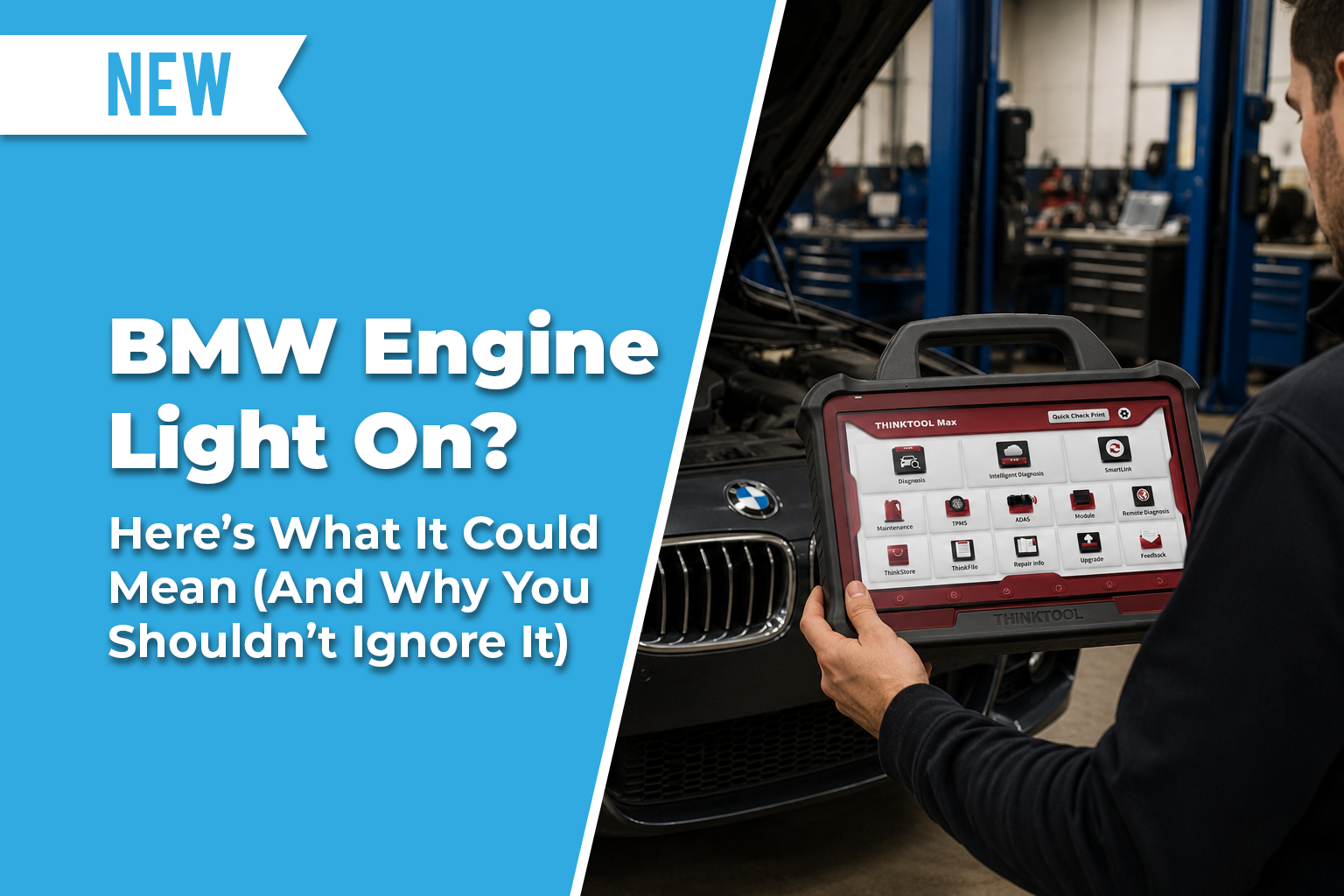
Professional European diagnostic equipment can access:
- Manufacturer-specific fault codes
- Live sensor data
- Individual control modules
- Service history information
- Adaptation values
- Software updates
- Coding functions
Simply clearing the fault code without identifying the underlying cause often means the warning light returns days later.
Accurate diagnosis is the key to fixing the actual problem rather than simply resetting the warning.
Why You Shouldn’t Ignore the Engine Light
Continuing to drive with an illuminated engine warning light may lead to additional repairs.
For example:
- A faulty ignition coil can damage the catalytic converter.
- A cooling system fault can overheat the engine.
- A vacuum leak may increase fuel consumption and carbon buildup.
- A minor sensor fault can eventually affect multiple engine management systems.
- What starts as a relatively inexpensive repair may become a much larger job if left too long.
- Regular Servicing Helps Prevent Engine Warning Lights
- Routine servicing doesn’t just involve changing the oil.
- A comprehensive inspection allows technicians to identify worn components before they trigger dashboard warnings.
- Regular servicing includes checking:
- Ignition components
- Battery condition
- Cooling system
- Fluid levels
- Air filters
- Belts
- Sensors
- Charging system
- Fault memory
- Preventative maintenance is almost always less expensive than reactive repairs.
Professional BMW Diagnostics in Brisbane
At Sandgate Auto Electrics & Automotive Services, we use professional diagnostic equipment to accurately identify the cause of BMW engine warning lights rather than simply clearing the code.
Our experienced technicians regularly work on BMW and other European vehicles, allowing us to diagnose electrical, engine management and electronic faults efficiently.
Whether the issue is a failed sensor, ignition fault, turbocharger problem or something more complex, we’ll explain what we’ve found and recommend the most appropriate repair.
If your BMW engine warning light has appeared, don’t wait until it develops into a more expensive problem. Having it checked early could save you significant repair costs and help keep your vehicle performing the way BMW intended.
Frequently Asked Questions
Q. Why is my BMW engine light on but the car feels normal?
Many faults are detected before you notice any changes in how the vehicle drives. Sensors can identify small issues long before they become obvious. Even if the car feels fine, it’s worth having the fault diagnosed.
Q. Can I keep driving with my BMW engine warning light on?
If the light is steady and the vehicle is driving normally, you can usually drive cautiously for a short period while arranging an inspection. If the light is flashing or the vehicle is running poorly, stop driving as soon as it is safe to do so and seek professional assistance.
Q. Will disconnecting the battery reset the engine light?
Sometimes, but it’s not recommended. Disconnecting the battery may erase fault codes temporarily without fixing the underlying problem. In many cases, the warning light will return once the fault is detected again.
Q. Do European cars get more engine warning lights than other vehicles?
Not necessarily. European vehicles simply monitor more systems using more sophisticated electronics and sensors. This allows them to detect developing problems earlier than many other vehicles, which can actually help prevent major failures when addressed promptly.
Q. What should I do if my BMW engine warning light comes on?
Avoid ignoring it. Arrange for the vehicle to be professionally diagnosed as soon as practical. Identifying the cause early often prevents more extensive and expensive repairs later.
Q. Is Your BMW Engine Light On? We’re Here to Help.
If your BMW’s engine warning light has come on, don’t ignore it or simply clear the fault code and hope for the best. The sooner the underlying issue is diagnosed, the more likely it is to be a straightforward and cost-effective repair.
At Sandgate Auto Electrics & Automotive Services, our experienced technicians use professional diagnostic equipment to accurately identify faults in BMWs and other European vehicles. Whether it’s an electrical issue, sensor fault, ignition problem or something more complex, we’ll explain what’s happening in plain English and recommend the right repair – no guesswork.
We also service and repair a wide range of European makes, including Mercedes-Benz, Audi, Volkswagen, MINI, Land Rover, Volvo, Peugeot, Citroën, Porsche and Skoda.
If your engine light is on, or your vehicle isn’t performing as it should, we’d be happy to help.
Why Choose Sandgate Auto Electrics?
✔ Over 50 years serving Brisbane motorists
✔ Experienced with BMW and European vehicles
✔ Advanced diagnostic equipment
✔ Honest advice and transparent pricing
✔ Auto electrical and mechanical repairs under one roof
✔ Trusted by thousands of Brisbane vehicle owners
Need assistance? Get in touch with the team.
Request a Quote Online

 Call us:
  Visit us: 101 Connaught Street, Sandgate Qld 4017
 Email: