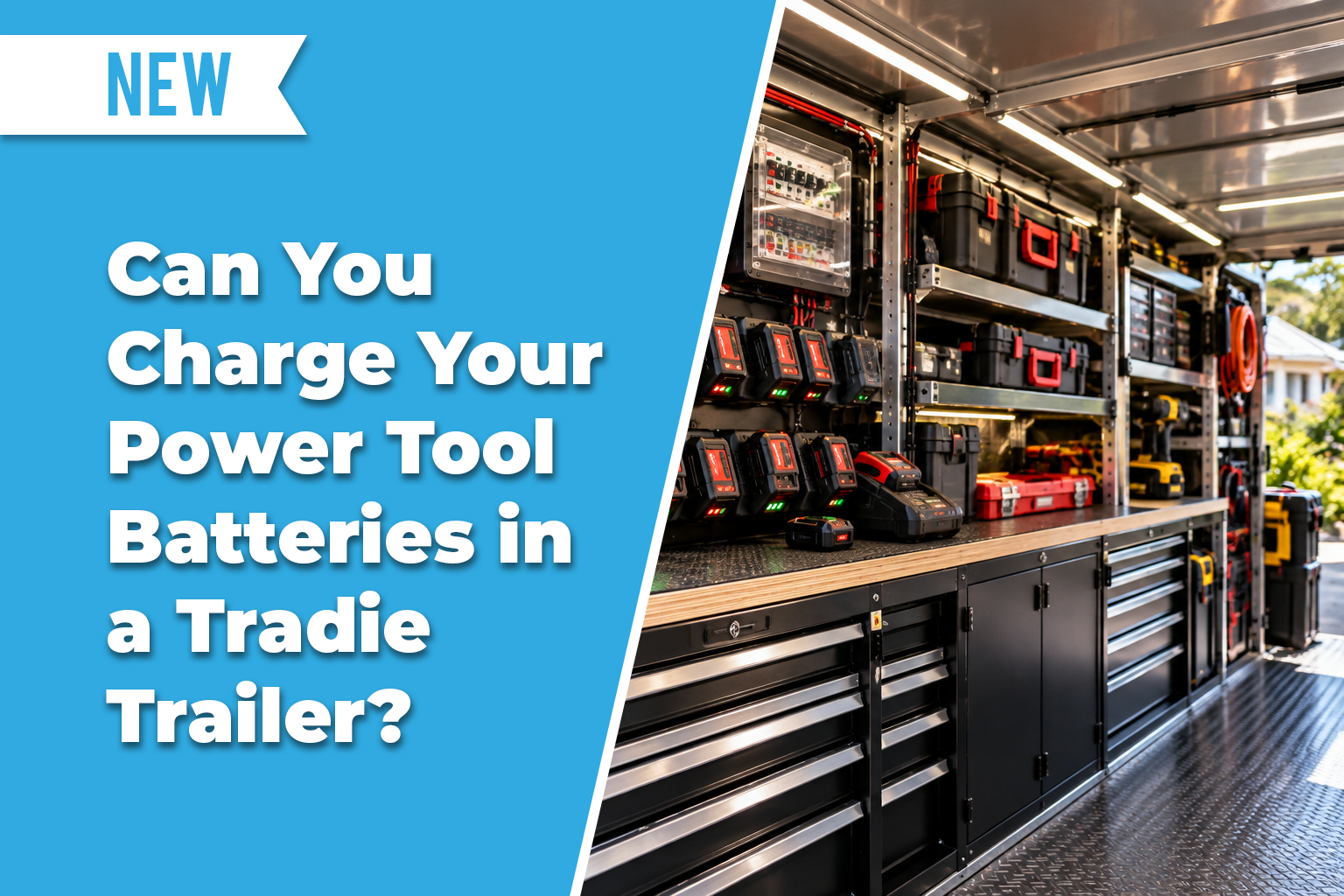
Yes — you can charge power tool batteries from a properly designed tradie trailer electrical system.
But there is a big difference between:
“Can I plug a charger into an inverter?”
and:
“Can my trailer reliably charge all the batteries I use during a normal workday without leaving me with a flat trailer battery?”
That second question is the important one.
A mobile charging setup needs to account for how many chargers you use, their power consumption, how long they run, whether several operate at once, how the trailer battery is recharged and what other electrical equipment is already drawing power.
At Sandgate Auto Electrics & Automotive Services, the best starting point isn’t choosing an inverter or battery size.
It’s making a list of the equipment you actually need to run.
Here’s how to approach it.
Start With Your Tool Charger Wattage
Before buying anything, look at your chargers.
Every charger has a power requirement.
Depending on the manufacturer, you may find electrical information on:
- the charger label
- the power supply
- the product manual
- the manufacturer’s specifications
The number you are particularly interested in is the charger’s power demand in watts, or enough information to determine its electrical requirement.
Then ask three questions:
- How many chargers do I use?
- How long does each charger normally operate during a workday?
- How many need to run at the same time?
These numbers matter far more than simply saying:
“I want an inverter big enough to charge my tools.”
Two tradies with exactly the same trailer may need completely different electrical systems.
Why Simultaneous Charging Matters
Imagine you own four battery chargers.
That doesn’t necessarily mean your system needs to run all four at once.
If you normally charge one battery during lunch and another later in the day, your peak electrical demand may be relatively modest.
But if your crew comes back to the trailer at 10 am and plugs four depleted tool batteries in simultaneously, your inverter needs to handle that combined load.
This is the difference between energy demand and peak power demand.
Peak power
This is how much electrical power the system needs to supply at one time.
Daily energy
This is how much total electricity you consume across the whole day.
You need to understand both.
An inverter that can handle the chargers simultaneously does not automatically mean the battery has enough usable energy to keep doing it all day.
Option 1: Charging From the Trailer Battery
One common setup uses a dedicated battery in the trailer.
That battery can supply energy to the electrical system while the trailer is disconnected from the tow vehicle.
Depending on the fit-out, it may support equipment such as:
- power tool chargers
- interior lighting
- exterior lighting
- USB outlets
- cameras
- alarms
- GPS tracking
- other low-voltage accessories
For standard mains-powered tool chargers, the trailer battery will usually need to supply an inverter, which converts the trailer’s DC battery power into the AC power required by the charger.
The important question becomes:
How much energy are you taking out of the trailer battery each day, and how are you putting it back?
Option 2: Charging Power Tools Through an Inverter
An inverter allows suitable mains-powered equipment to operate from a battery system.
For tradie trailers, that can make it possible to use the manufacturer’s normal mains charger while away from a power point.
But inverter selection shouldn’t begin with:
“What size inverter is popular?”
It should begin with your equipment list.
Add up the chargers that could realistically operate at the same time.
Then consider other AC loads that may also operate through the inverter.
For example:
- laptop chargers
- test equipment
- small workshop equipment
- other mains accessories
The inverter must be suitable for the expected load, and the rest of the electrical system must also be designed to support it.
A bigger inverter by itself does not create more stored energy.
It simply increases the amount of AC power the system may be capable of supplying.
Don’t Buy the Inverter Before Doing the Maths
This is a common mistake.
Someone buys a large inverter because it “should run everything.”
Then they install it on a battery system that cannot support the expected workload.
Or they discover their actual charging demand is much lower and they’ve paid for capacity they’ll rarely use.
The better order is:
1. List the equipment.
2. Record its power demand.
3. Estimate daily operating time.
4. Identify what runs simultaneously.
5. Work out the daily energy requirement.
6. Design the battery, charging and inverter system around that requirement.
That gives you a system based on real usage instead of guesswork.
A Simple Worked Example
Let’s use a hypothetical example.
A Brisbane electrician has a work trailer containing two power tool chargers.
Each charger draws approximately 180 watts while operating.
On a typical workday, both chargers operate at the same time for about 1.5 hours in total.
Step 1: Calculate the simultaneous load
Two chargers:
180 W + 180 W = 360 W
So the charging setup needs to comfortably support that operating load, along with any other equipment that may be running at the same time.
Step 2: Calculate the daily AC energy
If both chargers operate for 1.5 hours:
360 W × 1.5 hours = 540 Wh
That means the chargers consume approximately 540 watt-hours of AC energy in this simplified example.
Step 3: Account for system losses
An inverter is not 100% efficient.
If we use an illustrative 90% efficiency for the calculation:
540 Wh ÷ 0.90 ≈ 600 Wh
So the battery system would need to supply roughly 600 Wh to deliver that 540 Wh of AC charging energy.
That is only the tool charging.
It does not yet include:
- lighting
- alarm
- GPS tracker
- USB charging
- other equipment
- standby loads
- reserve capacity
And it does not tell us what battery size you should buy.
That decision depends on battery type, allowable depth of discharge, charging opportunities, reserve requirements and the rest of the trailer’s electrical load.
This is why there isn’t one universal “tradie trailer battery size.”
What If You Have Fast Chargers?
Fast chargers can change the calculation considerably.
Their advantage is obvious:
Your tool batteries can potentially be returned to service faster.
But faster charging may also mean higher power demand.
If multiple high-powered chargers operate simultaneously, the required inverter and battery-system capability can increase quickly.
That doesn’t mean fast chargers are a problem.
It means they need to be included accurately in the design.
Bring the exact charger specifications to your installer rather than simply saying you have “four cordless chargers.”
Can You Charge Tool Batteries While Driving?
Potentially, yes.
For many tradie setups, charging the trailer battery while driving is one of the most useful ways to replace the energy used during the workday.
The key point is that the trailer battery should not simply be treated like an extension of the vehicle battery without proper charging control.
Modern tow vehicles and auxiliary battery systems can have different charging characteristics.
The appropriate charging arrangement depends on factors such as:
- tow vehicle
- trailer battery type
- charging requirements
- cable length
- current demand
- battery management
- existing trailer wiring
A properly designed DC charging system can allow the tow vehicle to contribute to recharging the trailer battery while you’re moving between jobs.
Why Driving Time Matters
Suppose you use a significant amount of trailer power during the day but only drive ten minutes home.
That provides a very different charging opportunity from someone who drives an hour between sites.
This is why the question:
“Can it charge while driving?”
is only the beginning.
The better question is:
“Can my normal driving pattern replace enough of the energy I use?”
If the answer is no, you’ll need another charging source.
Mains Charging Overnight
For many tradies, mains charging can be one of the simplest ways to keep the trailer ready.
You work during the day.
The trailer comes home.
You connect it to an appropriate mains charging system.
The battery is recharged overnight.
Then the trailer starts the next day with a properly charged battery.
This can be particularly useful when the trailer:
- returns to the same workshop each night
- is parked beside the house
- has regular access to mains power
- uses substantial energy during the day
The charging system still needs to suit the battery chemistry and capacity.
But having predictable overnight charging can reduce how heavily you need to rely on driving or solar.
Can Solar Charge Power Tool Batteries?
Solar can contribute.
But whether solar alone is enough depends on the numbers.
You need to consider:
- daily tool charging demand
- solar panel capacity
- available roof area
- shading
- weather
- season
- charge controller
- battery capacity
- other electrical loads
Solar generation also changes throughout the day.
A panel’s advertised rating is not the same as assuming it will produce that exact output continuously from morning until evening.
This makes solar useful as part of many systems, but it should not automatically be treated as the only charging source.
A Better Strategy: Use Multiple Charging Sources
A practical mobile workshop may use several ways of replacing energy.
For example:
While driving:
DC charging contributes energy from the tow vehicle.
While parked during the day:
Solar contributes where conditions allow.
At home or the workshop:
Mains charging restores the battery fully.
That gives the system more opportunities to recover the energy consumed by chargers and other equipment.
It also provides more flexibility when one charging source isn’t available.
Don’t Forget the Other Trailer Loads
Tool charging is rarely the only load.
Your trailer may also run:
- LED lighting
- exterior work lights
- USB outlets
- GPS tracking
- security alarm
- camera system
- fridge
- fans
- laptop chargers
- inverter standby
- other equipment
Every load contributes to the daily total.
Even small loads can matter if they operate continuously.
For example, a device drawing a relatively small amount of power for 24 hours may consume more total energy than a higher-powered device used briefly.
This is why daily energy calculations are so important.
Ventilation Matters Around Chargers and Inverters
Electrical equipment generates heat.
Power tool chargers, inverters and other components need to be installed according to the manufacturer’s ventilation and mounting requirements.
Don’t pack an inverter into a sealed compartment surrounded by tools simply because that location is convenient.
Likewise, chargers should not be installed where ventilation openings are obstructed.
Your fit-out should consider:
- airflow
- heat
- dust
- moisture
- physical damage
- cable protection
- service access
A mobile work trailer is a harsh environment.
Things move.
Tools get thrown around.
Dust gets everywhere.
Equipment should be mounted accordingly.
Charger Mounting Should Be Practical
If chargers will permanently live in the trailer, think about how they are used during a normal workday.
Good mounting should make batteries easy to insert and remove while preventing chargers from moving around during transport.
Consider:
- access
- ventilation
- cable routing
- protection from heavy tools
- visibility
- available wall or bench space
The neatest-looking fit-out isn’t necessarily the most practical.
Design it around how your team actually works.
How Many Batteries Can You Charge at Once?
There isn’t a universal number.
It depends on:
- charger power
- number of chargers
- inverter capacity
- battery-system capability
- other simultaneous loads
- available stored energy
Instead of asking:
“Can I run six chargers?”
list the actual chargers and calculate their combined demand.
You may discover that you never realistically need all six at the same time.
Or you may discover that simultaneous charging is essential because several workers depend on the trailer.
The system should reflect the real workflow.
Will Charging Tools Flatten the Trailer Battery?
It can if you use more energy than the system can replace.
Think of the trailer battery like a fuel tank.
Every charger takes energy out.
Driving, mains charging and solar put energy back in.
If more consistently leaves the battery than returns to it, eventually the battery becomes discharged.
The solution isn’t automatically a larger battery.
You need to look at:
- energy use
- battery capacity
- charging rate
- charging opportunities
- battery condition
A well-designed system balances all of them.
Designing a Reliable Tradie Trailer Charging System
Here’s the information worth collecting before asking for a quote.
Your chargers
For each one, record:
- make
- model
- rated input
- quantity
- typical charging time
Your batteries
How many tool batteries do you normally use in one day?
Simultaneous charging
How many chargers genuinely need to run together?
Other electrical equipment
List everything else the trailer needs to power.
Your driving pattern
How much time does the trailer normally spend being towed each day?
Mains access
Can you plug the trailer in overnight?
Solar opportunity
Is there enough suitable roof area, and does the trailer usually sit in open sunlight?
With that information, the electrical system can be designed around evidence rather than estimates.
Bring us the chargers
If you’re planning a mobile charging setup, bring Sandgate Auto Electrics a list of your chargers and how you use them during a normal workday.
We can then work from the real electrical demand instead of guessing at the battery and inverter size.
Request a quote: https://quote.sandgateautoelectrics.com.au
Frequently Asked Questions
Can I run power tool chargers from an inverter?
Yes, a suitable inverter can supply AC power for compatible mains tool chargers, provided the inverter and battery system are designed for the required load. Check the actual input requirements of the chargers and include any other equipment that may operate at the same time before selecting the inverter.
How many tool batteries can I charge at once?
There isn’t a fixed number because the answer depends on the chargers’ combined power demand and the capabilities of the inverter and battery system. Add up the equipment that will realistically operate simultaneously instead of choosing a system based only on the number of charger slots.
Will charging power tools flatten the trailer battery?
It can if the daily energy used by the chargers and other equipment exceeds what the battery and charging system can provide. The solution is to calculate daily demand and make sure the system has enough stored energy and sufficient opportunities to recharge.
Can I charge the trailer battery while towing?
A properly designed charging system can potentially recharge a trailer battery from the tow vehicle while driving. The correct setup depends on the tow vehicle, battery system, required charge rate and wiring arrangement, so it should be designed for the actual combination rather than treated as a generic connection.
Is solar enough for power-tool charging?
Solar may contribute significantly to a tradie trailer’s energy needs, but whether it can cover all tool charging depends on daily consumption, available panel capacity, weather, shading and other loads. It is often more useful to consider solar alongside driving and mains charging rather than assuming it will always meet the full demand.
Build the System Around Your Workday
You absolutely can turn a tradie trailer into a mobile tool-charging station.
But don’t start by choosing a battery.
And don’t start by buying the biggest inverter you can find.
Start with your chargers and your daily workload.
Work out:
- what needs power
- how many chargers operate together
- how long they run
- what else uses electricity
- how much you drive
- whether you have mains charging
- what solar can realistically contribute
Then design the system around those numbers.
For tradies on Brisbane’s Northside, Sandgate Auto Electrics & Automotive Services can help design a trailer electrical system around your actual chargers and daily use.
Bring us a list of your chargers and typical daily use so we can size the system correctly.
Get in touch.
📞 Call us: (07) 3269 3158
📍 Visit us: 101 Connaught Street, Sandgate Qld 4017
📧 Email: [email protected]