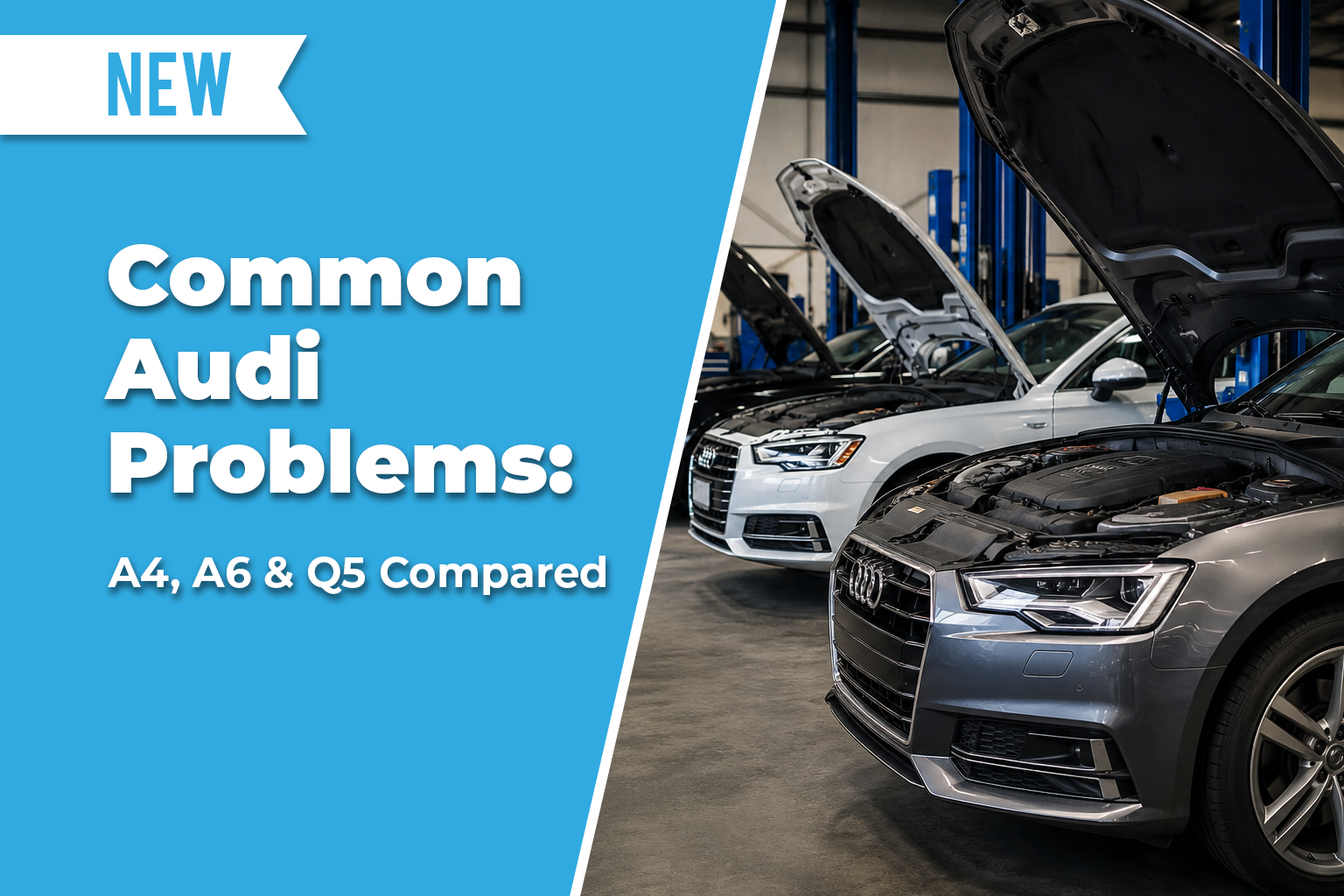
Audis are known for refined interiors, strong turbocharged engines and advanced technology.
That technology is also why diagnosing a fault is not always straightforward.
An Audi A4 that shakes at idle may have ignition, fuel-injection or carbon-deposit problems. A gearbox that hesitates in traffic may need servicing, adaptation or mechatronic diagnosis—but some low-speed behaviour is simply a characteristic of a dual-clutch transmission.
An Audi A6 with a blank multimedia screen could have a software problem, weak battery or damaged wiring. A Q5 with reduced power may have a faulty turbocharger, but it could also have a leaking charge pipe, disconnected wastegate linkage or boost-control fault.
This guide compares the most important Audi common problems affecting the A4, A6 and Q5, including the symptoms owners should watch for and why accurate diagnosis matters before expensive parts are replaced.
Common Audi Problems at a Glance
| Audi model |
Commonly investigated areas |
Warning signs |
| Audi A4 |
Intake carbon buildup, S tronic gearbox faults, ignition and boost issues |
Rough idle, misfires, hesitation, gearbox warning |
| Audi A6 |
MMI faults, wiring issues, battery drain and 48-volt electrical problems |
Blank screen, electrical warnings, no-start condition |
| Audi Q5 |
Turbo underboost, intake leaks, suspension noise and quattro drivetrain vibration |
Loss of power, whistling, creaking, vibration on tight turns |
These issues do not affect every Audi.
The risk depends on the vehicle’s model year, engine, gearbox, drivetrain, software version, service history and previous repairs.
Common Audi A4 Problems
The Audi A4 has been offered with several petrol, diesel and electrified powertrains across multiple generations.
This means there is no single list of faults that applies to every A4. However, two areas receive considerable attention from owners: intake carbon buildup and S tronic dual-clutch transmission behaviour.
1. Carbon Buildup on Direct-Injection Engines
Many Audi petrol engines use direct fuel injection.
In a traditional port-injected engine, fuel is sprayed before the intake valve and can help wash deposits from the valve surface. In a direct-injection engine, fuel is injected directly into the combustion chamber, so it does not provide the same cleaning effect on the back of the intake valves.
Over time, oil vapour and combustion residue can collect in the intake system.
Audi’s own technical information distinguishes between ordinary fuel-system deposits and carbon on the intake valves of FSI direct-injection engines. Audi states that a fuel-tank additive can clean injectors and combustion chambers, but directs technicians to a separate repair procedure when carbon must be removed from FSI intake valves.
Symptoms of Audi Carbon Buildup
Possible symptoms include:
- Rough idle, particularly after a cold start
- Engine misfires
- Check-engine light
- Hesitation under acceleration
- Reduced engine performance
- Uneven power delivery
- Increased fuel consumption
- Difficult starting
- Misfire codes such as P0300 or cylinder-specific P0301–P0304 faults
These symptoms can also be caused by failed ignition coils, worn spark plugs, injectors, vacuum leaks, low compression or incorrect fuel pressure.
Carbon buildup should therefore be confirmed through testing rather than assumed from mileage alone.
Does Fuel Additive Remove Audi Intake Carbon?
Not necessarily.
A fuel additive may help clean injectors and the combustion chamber, but fuel does not pass across the intake valves in the same way on a direct-injection engine. Audi’s technical bulletin specifically separates intake-valve carbon removal on FSI engines from routine fuel-additive treatment.
When significant intake-valve contamination is confirmed, the repair may involve physically cleaning the affected surfaces.
The correct method depends on:
- Engine type
- Level of contamination
- Intake-manifold design
- Manufacturer repair information
- Whether other faults are present
A workshop should diagnose the cause of the misfire before recommending carbon cleaning.
2. Audi A4 S Tronic and DSG Gearbox Issues
Audi generally uses the S tronic name for its dual-clutch transmissions. Owners and independent workshops may also refer to these units as DSG gearboxes because they use the Volkswagen Group’s dual-clutch transmission technology.
A dual-clutch transmission operates differently from a conventional torque-converter automatic.
It can feel more direct and responsive once moving, but may also produce different behaviour when:
- Moving away from a stop
- Reversing slowly
- Crawling in traffic
- Parking on an incline
- Changing between first and second gear
A slight pause does not automatically mean the gearbox is failing. Persistent shuddering, harsh engagement or warning messages are different and should be investigated.
Warning Signs of Audi DSG Gearbox Problems
Book a diagnostic assessment when you notice:
- Shuddering when moving away
- Severe hesitation before the car moves
- Harsh or delayed gear engagement
- Gearbox malfunction warning
- Loss of reverse
- Transmission remaining in one gear
- Flashing gear-position display
- Unusual clunking during changes
- Transmission fluid leaks
- Burning smell
- Fault codes stored in the transmission control module
Audi has issued technical guidance for certain 2020–2023 A4, A6 and Q5 vehicles fitted with the DL382 transmission where gearbox-malfunction warnings and pressure-control fault codes were stored. The specified diagnosis depended on the particular fault codes and vehicle configuration rather than assuming the complete transmission had failed.
What Is a Mechatronic Unit?
The mechatronic unit combines electronic control, sensors and hydraulic components that operate the gearbox.
Potential faults can involve:
- Solenoids
- Hydraulic pressure
- Internal wiring
- Speed sensors
- Control-module software
- Circuit boards
- Valve-body components
Audi technical information for certain S tronic units has included procedures involving mechatronic circuit-board or valve-body diagnosis rather than complete gearbox replacement.
This is why a transmission fault code should be treated as the beginning of the diagnostic process—not proof that the whole gearbox needs replacing.
3. A4 Turbo and Boost Problems
An Audi A4 that loses power or displays an underboost code may have several possible causes.
These can include:
- Split intake or intercooler hose
- Boost leak
- Wastegate problem
- Faulty diverter valve
- Boost-pressure sensor fault
- Wiring problem
- Turbocharger wear
- Exhaust restriction
Audi documented an underboost issue on certain 2013–2014 A4, A6 and Q5 models with the 2.0 TFSI engine where the turbo wastegate linkage could become disconnected. The symptoms included reduced power and fault code P0299.
The presence of P0299 therefore does not automatically mean a new turbocharger is required.
Common Audi A6 Problems
The A6 is a larger and more technology-heavy vehicle than the A4.
Depending on the year and specification, it may include multiple displays, advanced lighting, driver-assistance systems, mild-hybrid components and a large number of interconnected control modules.
Electrical faults can therefore produce symptoms in systems that initially appear unrelated.
1. MMI Screen and Infotainment Problems
Audi’s Multi Media Interface, commonly called MMI, controls functions such as:
- Navigation
- Audio
- Phone connection
- Vehicle settings
- Cameras
- Climate-related controls
- Online and emergency-call functions
Common complaints can include:
- Black or blank screen
- System repeatedly restarting
- Frozen touchscreen
- Delayed startup
- Bluetooth dropping out
- No audio
- Navigation failing to load
- Emergency-call warning
- Parking functions becoming unavailable
A failed screen is only one possible cause.
The fault may instead involve:
- Software
- Wiring
- Low battery voltage
- A multimedia control module
- A communication-bus problem
- A damaged connector
- Another module interrupting the network
Audi issued a technical bulletin for certain 2019 A6 and A7 vehicles where a black MMI display could appear alongside a parking-brake malfunction. The documented cause was a wiring harness underneath the centre console that could be pinched during assembly, interrupting communication between control modules.
This demonstrates why replacing the touchscreen without testing the wiring and stored communication faults can waste money.
2. Battery Drain and Low-Voltage Faults
Modern Audis are extremely sensitive to battery condition.
A weak battery may still start the engine while causing problems such as:
- Multiple warning lights
- Slow or failed module startup
- Keyless-entry problems
- Start-stop system unavailable
- MMI restarting
- Parking-sensor faults
- Driver-assistance warnings
- Intermittent no-start condition
When battery voltage falls, control modules may shut down or lose communication. That can produce several fault codes even when the modules themselves are not defective.
Correct diagnosis should include:
- Battery state-of-health test
- Charging-system test
- Parasitic-current test
- Full vehicle scan
- Review of battery-management data
- Inspection of aftermarket accessories
- Confirmation that the correct battery type was installed
- Battery registration or adaptation where required
Replacing the battery without finding the cause of the discharge may only provide temporary relief.
3. A6 48-Volt Electrical System Faults
Certain later Audi A6 models use a 48-volt mild-hybrid electrical system in addition to the traditional 12-volt system.
Audi issued technical guidance explaining that, on affected vehicles, a 48-volt electrical warning could lead to the 12-volt system becoming discharged if ignored. This could eventually result in the vehicle stalling or failing to start. The documented remedy for applicable vehicles involved updated starter-generator control software.
Possible warning signs include:
- “Electrical system: fault” message
- Red or yellow battery symbol
- Start-stop system unavailable
- Repeated low-battery warnings
- No-start condition
- Vehicle stalling
- Multiple electronic systems becoming unavailable
A 48-volt warning should not be treated like a routine battery reminder.
The vehicle should be scanned, and the 12-volt battery, 48-volt system, starter-generator, wiring and software status should be assessed.
4. Why A6 Electrical Diagnosis Can Become Expensive
Replacing electronic components based only on the warning displayed can become extremely costly.
A single wiring fault may affect:
- Infotainment
- Parking brake
- Cameras
- Instrument cluster
- Driver assistance
- Central locking
- Battery management
The correct process is to identify which control module first stopped communicating and determine whether the cause is voltage, wiring, software or a failed module.
Common Audi Q5 Problems
The Audi Q5 combines turbocharged engines, quattro all-wheel drive, electronic driver-assistance systems and a more heavily loaded SUV suspension.
Frequently investigated areas include turbo underboost, suspension noise and drivetrain vibration during slow, tight turns.
1. Audi Q5 Turbo Problems
Possible signs of a Q5 turbo or boost-system fault include:
- Reduced engine power
- Check-engine light
- “Drive system: fault” message
- P0299 underboost fault
- Whistling or hissing under acceleration
- Excessive smoke
- Poor fuel economy
- Uneven acceleration
- Limp or restricted-performance mode
A Q5 displaying these symptoms does not automatically need a complete turbocharger.
Audi documented an underboost complaint affecting certain 2020–2022 Q5, Q5 Sportback and SQ5 variants. The bulletin instructed technicians to compare specified and actual boost pressure and inspect the charge-air system. On applicable vehicles, material accumulation inside a post-intercooler charge pipe could restrict boost and cause loss of power.
Other underboost causes can include:
- Loose hose connection
- Split charge pipe
- Intake leak
- Wastegate fault
- Vacuum or electronic actuator problem
- Damaged wiring
- Faulty boost sensor
- Coolant contamination affecting a boost-control valve
- Worn turbocharger
Audi has also documented cases where coolant leaking from a pump contaminated a switching valve and produced an underboost fault, highlighting how a fault code can point to secondary damage rather than the original cause.
Turbo Whistle: Normal or a Fault?
Turbocharged engines naturally produce some noise.
A new, loud or changing whistle should still be investigated—especially when accompanied by loss of power, smoke or a warning light.
Audi issued a bulletin for certain 2021–2023 A4 and Q5 models where a distinct whistle between approximately 1,500 and 2,200 rpm could be traced to the turbocharger. Audi required technicians to reproduce and measure the noise before carrying out the specified repair.
This reinforces the importance of confirming the source rather than replacing parts based on sound alone.
2. Audi Q5 Suspension Problems
The Q5 is heavier and taller than an A4, placing different loads on its suspension, tyres and wheel bearings.
Common complaints can include:
- Creaking over speed bumps
- Knocking on uneven roads
- Clicking while parking
- Loose or vague steering
- Uneven tyre wear
- Steering-wheel vibration
- Vehicle pulling to one side
- Air-suspension warning on equipped models
Possible causes include:
- Control-arm bushes
- Ball joints
- Strut mounts
- Shock absorbers
- Wheel bearings
- Steering components
- Incorrect wheel alignment
- Tyres with uneven wear
- Air-suspension electronics
Not every suspension noise means that the shock absorber has failed.
Noise can travel through the subframe and body, making the source difficult to locate without a road test and physical inspection.
Certain Q5 models equipped with adaptive air suspension have also been covered by Audi technical information relating to suspension warnings and communication faults in the suspension-control system. On affected vehicles, updated software was introduced for specific stored faults.
3. Q5 Quattro Vibration or Binding in Tight Turns
Some Q5 owners report:
- Humming during U-turns
- Vibration at full steering lock
- Binding while manoeuvring
- Droning from the rear of the vehicle
- Rubbing sensation in tight car-park turns
Audi has issued repeated technical guidance covering certain quattro ultra vehicles, including Q5 and SQ5 models, where vibrations or binding could occur during tight turns. The specified diagnostic process involved reproducing the concern, checking the drivetrain and assessing the all-wheel-drive clutch rather than immediately replacing the transmission.
Other factors can produce similar symptoms, including:
- Mismatched tyres
- Different tyre tread depths
- Incorrect tyre pressures
- Wheel-alignment problems
- Worn wheel bearings
- Drivetrain mounts
- Differential or propeller-shaft faults
All four tyres should have compatible size, construction and wear because differences in rolling circumference can affect an all-wheel-drive system.
Are Audi DSG Gearbox Problems Always Serious?
No.
Some low-speed characteristics are normal for a dual-clutch transmission. However, deterioration or new symptoms should not be ignored.
A healthy S tronic gearbox should not repeatedly:
- Slam into gear
- Lose drive
- Refuse reverse
- Display malfunction warnings
- Shudder severely
- Leak transmission fluid
- Become stuck in emergency mode
Servicing requirements vary between transmission types. Not every Audi gearbox uses the same fluid, filter, service interval or adaptation procedure.
The workshop should confirm the gearbox code or vehicle identification details before quoting a DSG or S tronic service.
When Does an Audi Need Carbon Cleaning?
Carbon cleaning should be based on diagnosis—not simply age or kilometres.
An inspection may be appropriate when the vehicle has:
- Persistent cold-start misfires
- Rough idle that remains after ignition repairs
- Confirmed intake-valve deposits
- Reduced airflow or engine performance
- Misfire codes without another clear cause
- Borescope evidence of significant contamination
Carbon cleaning will not repair:
- Failed ignition coils
- Worn spark plugs
- Faulty injectors
- Vacuum leaks
- Low compression
- Damaged turbocharger
- Incorrect camshaft timing
- Faulty sensors
Those problems require separate repair.
Why a Full Audi Diagnostic Scan Matters
A basic generic scan tool may read the engine computer but miss faults stored in:
- Transmission
- Infotainment
- Battery management
- Gateway module
- All-wheel-drive system
- Suspension
- Parking brake
- Driver-assistance system
- Climate control
- Steering
- Body electronics
A professional Audi diagnostic process may include:
- Confirming the exact symptoms with the owner
- Scanning every available control module
- Recording active, pending and historical faults
- Testing the battery and charging system
- Reviewing live engine and gearbox data
- Inspecting wiring, connectors and earth points
- Performing smoke or pressure testing for intake leaks
- Checking transmission fluid condition and service history
- Road-testing the vehicle under the conditions that trigger the fault
- Retesting after repairs
Clearing the codes without fixing the underlying cause only removes the warning temporarily.
Buying a Used Audi A4, A6 or Q5
Before buying a used Audi, arrange a detailed pre-purchase inspection.
Check the Service History
Look for evidence of:
- Regular engine-oil changes
- Correct oil specification
- Spark-plug replacement
- S tronic or gearbox servicing
- Cooling-system repairs
- Battery replacement and registration
- Software updates
- Suspension repairs
- Turbo or intake-system work
Missing records do not prove the vehicle is faulty, but they increase uncertainty.
Start the Engine From Cold
A cold start can reveal:
- Misfires
- Timing noise
- Rough idle
- Smoke
- Slow starting
- Battery weakness
A seller may warm the vehicle before inspection to hide symptoms that only appear during the first start of the day.
Test the Gearbox Thoroughly
Drive the car through:
- Slow traffic
- Reverse parking
- Gentle acceleration
- Firm acceleration
- Inclines
- Stop-start manoeuvres
Pay attention to severe shuddering, delayed engagement or warning messages.
Test Every Electrical Function
In an A6 especially, test:
- MMI screens
- Cameras
- Audio
- Bluetooth
- Navigation
- Parking brake
- Climate control
- Electric seats
- Keyless entry
- Driver-assistance systems
- Headlights and interior lighting
An impressive feature list has little value when several systems do not work.
Inspect Q5 Tyres and Suspension
Check that all four tyres have:
- Correct size
- Suitable load rating
- Similar tread depth
- Even wear
- Compatible construction
Uneven wear may indicate wheel-alignment, suspension or drivetrain concerns.
When Should You Stop Driving Your Audi?
Stop driving and seek professional advice when you notice:
- Red oil-pressure warning
- Severe overheating
- Flashing check-engine light with heavy misfiring
- Gearbox refusing to select or hold a gear
- Burning smell or smoke
- Sudden major power loss
- Red electrical-system warning
- Repeated engine stalling
- Suspension dropping onto one corner
- Loud metallic knocking
- Significant fuel or coolant leak
Continuing to drive can turn a manageable fault into major engine, gearbox or turbocharger damage.
Audi Servicing and Diagnostics in Sandgate
Audi faults often involve mechanical and electrical systems working together.
A rough-running A4 may require carbon-buildup assessment, but ignition and fuel faults must be ruled out first.
An A6 electrical warning may come from the battery, wiring, software or communication between modules.
A Q5 underboost code may be caused by a turbocharger, but it may also result from a charge-air leak or control fault.
Sandgate Auto Electrics & Automotive Services offers repairs and servicing on European vehicles, including Audi, and provides mechanical servicing, vehicle diagnostics, electrical repairs, gearbox repairs and suspension work. The workshop states that it has qualified mechanics and auto electricians, modern diagnostic equipment and facilities for European-car servicing.
For Audi owners in Sandgate, Brighton, Deagon, Shorncliffe, Bracken Ridge and Brisbane’s northside, a local diagnostic assessment can help determine:
- Which faults are currently active
- Whether several warnings share one cause
- Whether carbon cleaning is appropriate
- Whether the S tronic gearbox needs servicing or diagnosis
- Whether a turbo fault is actually caused by a boost leak
- Which repairs should be prioritised
The workshop is located at 101 Connaught Street, Sandgate QLD 4017 and can be contacted on (07) 3269 3158.
Frequently Asked Questions
Q. What are the most common Audi problems?
Frequently investigated issues include intake carbon buildup on some direct-injection engines, S tronic gearbox faults, electrical and infotainment problems, battery-related warnings, turbo underboost and suspension noise. The exact risks depend on the model, engine, gearbox and year.
Q. Does every Audi A4 suffer from carbon buildup?
No. The amount of buildup varies according to engine design, mileage, driving conditions, maintenance and previous repairs. Carbon contamination should be confirmed before cleaning is recommended.
Q. Will a fuel additive clean Audi intake valves?
Fuel additives may clean injectors and combustion chambers, but Audi provides a separate procedure for removing deposits from FSI intake valves because fuel does not wash across them in the same way.
Q. What are the symptoms of Audi carbon buildup?
Symptoms can include cold-start misfires, rough idle, check-engine light, hesitation and reduced performance. These symptoms can also come from ignition, fuel or mechanical faults.
Q. Is Audi S tronic the same as DSG?
S tronic is Audi’s name for its dual-clutch transmission. DSG is the commonly used Volkswagen Group term for similar dual-clutch technology.
Q. Does S tronic hesitation mean the gearbox is failing?
Not always. Some low-speed hesitation can be characteristic of a dual-clutch gearbox. Severe shuddering, loss of drive, warning messages or delayed engagement require diagnosis.
Q. Why does my Audi A6 screen keep going black?
Possible causes include software, low battery voltage, a failed control module, damaged wiring or a communication fault. Certain 2019 A6 vehicles had documented wiring concerns that could affect the MMI and parking brake.
Q. Can a weak battery cause multiple Audi warning lights?
Yes. Low voltage can prevent modules from starting or communicating correctly, creating several warnings from one underlying battery or charging problem.
Q. Does a P0299 code mean my Q5 needs a new turbo?
No. P0299 indicates that actual boost is lower than expected. The cause could be a charge-pipe leak, loose hose, wastegate fault, sensor problem, control valve or turbocharger wear.
Q. Why does my Q5 vibrate during tight turns?
Possible causes include quattro drivetrain behaviour, all-wheel-drive clutch problems, mismatched tyres, wheel alignment, wheel bearings or drivetrain mounts. The concern should be reproduced and inspected before parts are replaced.
Q. Should I buy a used Audi with no warning lights?
Warning lights alone are not enough to judge condition. Fault codes may have been recently cleared. Arrange a complete diagnostic scan and pre-purchase inspection.
Keep Your Audi Performing the Way It Was Designed To
Whether you drive an Audi A4, A6 or Q5, understanding the most common issues can help you avoid unexpected breakdowns and reduce the risk of costly repairs. Preventative maintenance and accurate diagnostics are the key to keeping your Audi reliable and enjoyable to drive.
At Sandgate Auto Electrics & Automotive Services, we specialise in servicing and repairing Audi vehicles. From carbon cleaning and electrical diagnostics to turbocharger repairs, DSG transmission servicing and routine maintenance, our technicians have the experience and equipment to keep your Audi performing at its best.
Need assistance? Get in touch with the team.
Request a Quote Online