If you’re trying to improve the security of a work trailer, two of the most common electronic options are:
- a trailer alarm
- a GPS tracker
They sound similar because both are used for security.
But they actually solve different problems.
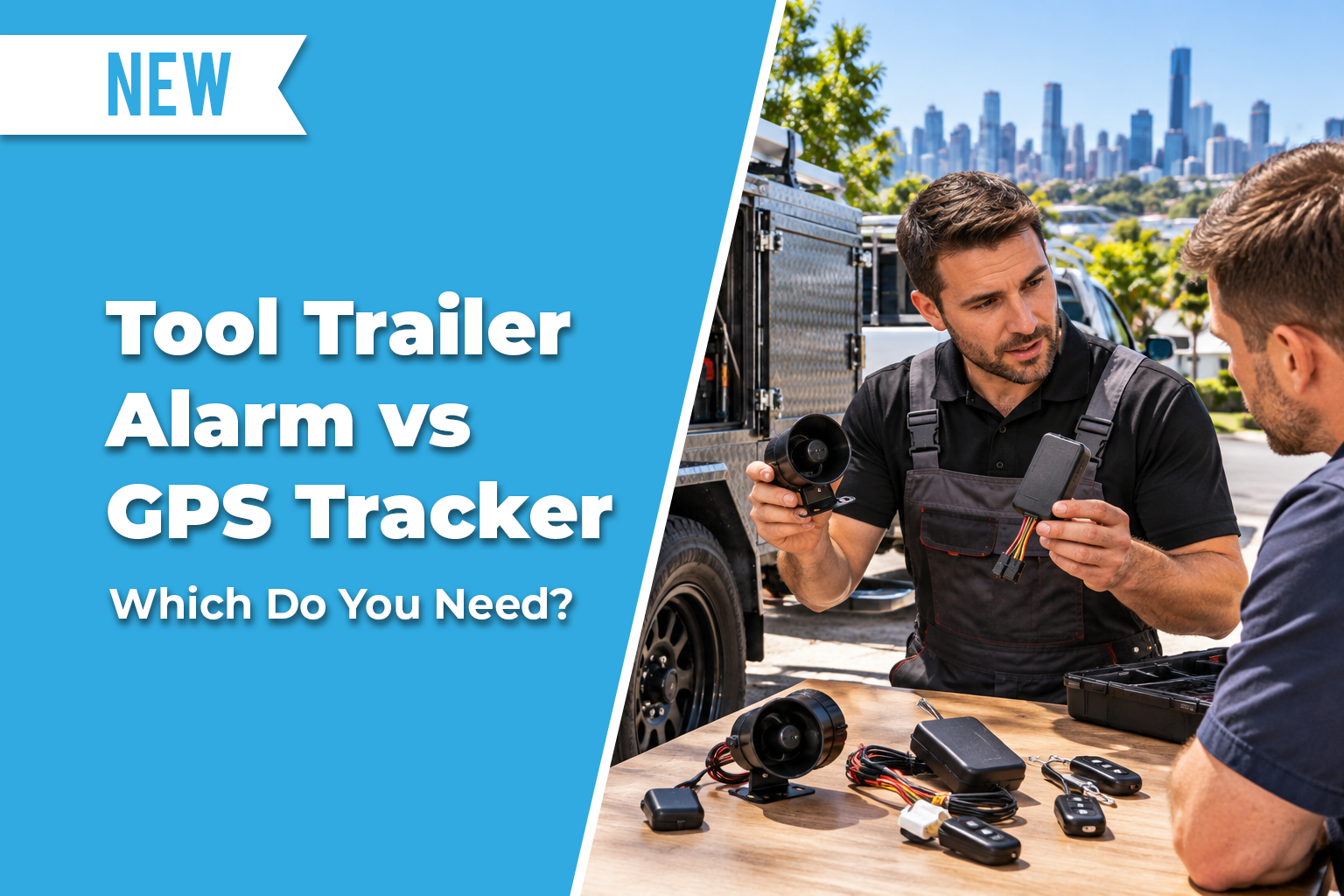
A trailer alarm is mainly about detecting interference and drawing attention to it.
A GPS tracker is mainly about monitoring location and movement.
For many tradies, the question isn’t simply which one is better.
It’s whether your trailer needs detection, tracking, or both.
At Sandgate Auto Electrics & Automotive Services, we recommend looking at where the trailer is parked, how often it travels, whether it has its own battery system and what you are trying to protect before choosing security equipment.
What Does a Tool Trailer Alarm Do?
A trailer alarm is designed to react when certain activity is detected.
Depending on the system, this might include:
- a door being opened
- movement
- impact
- tampering
- another monitored trigger
The system may then activate an audible siren or another type of alert, depending on the product.
The main purpose is detection and deterrence.
If someone starts interfering with your trailer, an alarm can potentially make that activity far more noticeable.
For a tradie trailer carrying expensive tools, that can be valuable.
But an alarm has limitations.
It doesn’t automatically tell you where the trailer has gone if someone manages to tow it away.
That’s where tracking comes in.
What Does a GPS Tracker Do?
A GPS tracker is primarily designed to monitor the trailer’s location.
Depending on the tracker and service, it may provide features such as:
- current location
- movement alerts
- geofencing
- trip history
- location history
- mobile-app monitoring
The main advantage is visibility.
If the trailer moves when it shouldn’t, a tracking system may be able to notify you and provide location information.
But a tracker shouldn’t be treated as a substitute for locks or alarms.
It usually doesn’t stop someone opening the trailer.
And it doesn’t necessarily stop the trailer being moved.
Its main job is monitoring and location.
Detection vs Tracking: The Key Difference
This is the simplest way to compare them.
Trailer alarm
Primary question:
Is someone interfering with my trailer right now?
GPS tracker
Primary question:
Where is my trailer, and has it moved?
Those are different problems.
Imagine your work trailer is sitting in your driveway overnight.
Someone starts forcing a side door.
An alarm may detect the activity and activate immediately.
A GPS tracker may not necessarily respond unless the trailer itself moves or the system includes additional sensors.
Now imagine someone connects the trailer to another vehicle and drives away.
A GPS tracker may become extremely valuable because it can provide location information.
The alarm and tracker complement each other because they operate at different stages of the incident.
Quick Comparison: Trailer Alarm vs GPS Tracker
| Feature |
Trailer Alarm |
GPS Tracker |
| Detects doors or tampering |
Often, depending on system |
Usually not the main function |
| Provides audible warning |
Yes, typically |
Usually no |
| Can provide movement alerts |
Some systems |
Common feature |
| Shows trailer location |
No |
Yes |
| Useful after trailer is moved |
Limited |
Yes |
| Requires power |
Yes |
Usually |
| May require mobile coverage |
Not always |
Commonly |
| May have ongoing subscription |
Product-dependent |
Often possible |
| Main purpose |
Detection and deterrence |
Tracking and monitoring |
This is why there isn’t a universal winner.
The better option depends on the problem you are trying to solve.
Will a Trailer Alarm Work When the Trailer Is Unhitched?
It can, but only if the alarm has an appropriate power source.
This is a critical consideration for work trailers.
A trailer may spend most of its life disconnected from the tow vehicle.
If the alarm depends entirely on power from the vehicle, it may stop operating once the trailer is unplugged.
A proper trailer security system therefore needs to consider:
- whether the trailer has its own battery
- battery capacity
- how the battery is charged
- how long the trailer sits unused
- how much current the security equipment consumes
Security equipment and the trailer power system should be planned together.
Can a GPS Tracker Alert You If the Trailer Moves?
Many modern trackers can provide movement-related notifications, depending on the product and service.
Examples may include:
- movement alerts
- geofence alerts
- ignition or power alerts
- location updates
A geofence lets you define an area around a location.
For example, if the trailer is normally parked at home overnight, the system may be able to alert you if it leaves that area.
However, features vary significantly.
Before choosing a tracker, ask exactly what the product can detect and how quickly alerts are delivered.
Do not assume every GPS tracker includes the same features.
Does a GPS Tracker Need Mobile Coverage?
Many vehicle and trailer trackers use two separate technologies.
GPS determines where the tracker is.
A mobile-data connection sends that information to the monitoring platform or app.
If the trailer moves through an area with poor network coverage, the tracker may not be able to send live updates immediately.
Depending on the system, it may store location data and upload it once coverage returns.
This makes mobile coverage an important consideration for trailers that regularly travel into regional or remote areas.
Ask the installer:
- which network the tracker uses
- how often it reports
- what happens when coverage is lost
- whether location history is stored
- how movement alerts work
How Much Data Does GPS Tracking Use?
The amount of mobile data used depends on the tracker and how frequently it communicates.
A tracker sending occasional position updates may use relatively little data compared with devices transmitting large amounts of media.
But data use is only part of the cost.
Some tracking systems include their connectivity within a subscription.
Others may require a separate SIM or service arrangement.
When comparing products, look at the total ongoing cost, not just data usage.
What Does a GPS Tracker Cost to Run?
There can be two main cost categories.
Up-front costs
These may include:
- tracker hardware
- installation
- additional power-system work
- antenna or accessory requirements
Ongoing costs
These may include:
- subscription fees
- SIM or mobile connectivity
- platform access
- app or monitoring services
The spreadsheet brief specifically calls for comparing these cost categories rather than publishing unsupported dollar figures.
So when comparing systems, ask:
What does this cost to install?
and
What does this cost to keep operating?
That gives you a much more useful comparison.
Can a Tracker Flatten the Trailer Battery?
Any electrical device that remains powered can contribute to battery drain.
A GPS tracker is often designed to consume relatively modest power, but the total electrical system still matters.
Battery drain becomes more likely when:
- the trailer sits unused for long periods
- the battery is old
- the battery capacity is too small
- the charging system is inadequate
- several security or electrical devices stay active
- there is another parasitic drain
This is why a tracker should be considered alongside the trailer’s battery and charging setup.
What About False Alarm Alerts?
False alerts are one of the biggest usability issues with security systems.
If a trailer alarm activates constantly because of harmless movement, the owner may eventually stop paying attention to it.
Likewise, if a GPS app sends too many unnecessary notifications, important alerts can get lost in the noise.
A useful security system should be configured so the alerts are meaningful.
Consider:
- where the trailer is normally parked
- how often it gets moved
- whether employees use it
- normal vibration or movement
- sensitivity settings
- geofence size
- notification preferences
The system should fit your routine rather than fighting against it.
When an Alarm Makes More Sense
A trailer alarm may be the stronger priority when:
- your biggest concern is someone breaking into the trailer
- the trailer carries valuable tools
- it is parked close enough for an audible alarm to be useful
- you want immediate detection of tampering
- the trailer already has reliable battery power
For example, a trailer parked beside your home or workshop every night may benefit from an alarm because you or nearby people can hear it quickly.
When a GPS Tracker Makes More Sense
A tracker may be a stronger priority when:
- the trailer travels frequently
- it is left at different job sites
- you want movement notifications
- you want to know where the trailer is
- the trailer may be parked away from you
- the trailer itself is highly valuable
This is particularly relevant for trailers that spend significant time away from the owner.
If you cannot hear an alarm from where you are, remote movement and location information may be more useful.
When You Should Consider Both
For many high-value work trailers, using both may make sense.
The alarm and tracker solve different problems.
Example
Imagine a tradie trailer parked overnight on Brisbane’s Northside.
At 2 am, someone begins forcing the rear door.
The alarm detects the interference and activates.
If the offenders leave, the alarm may have done its job.
But if they manage to connect the trailer and move it, the GPS tracker provides another layer.
This creates a sequence:
Alarm → detect the interference
Tracker → monitor movement and location
That is a much broader security strategy than relying on either system alone.
Physical Security Still Matters
Even if you install both an alarm and a tracker, do not ignore basic physical security.
Electronic systems should support—not replace—measures such as:
- quality door locks
- coupling locks
- wheel clamps
- secure chains where appropriate
- good parking choices
- lighting
- secure tool storage
A tracker is more useful when the trailer is difficult to steal in the first place.
And an alarm is more useful when the trailer already has strong physical barriers.
Think About the Trailer Battery Before Installing Either
An alarm and tracker both need reliable power.
Before fitting them, consider the trailer’s entire electrical system.
Ask:
- Does the trailer have its own battery?
- What type and capacity?
- How is it charged?
- Does it charge from the tow vehicle?
- Is there solar?
- Is mains charging available?
- How long does the trailer sit disconnected?
- What other electrical accessories are installed?
This matters because security equipment needs to remain operational while the trailer is parked.
If the battery is already marginal, security equipment can expose an existing power-system weakness.
Which Option Is Better for a Tradie Trailer?
Use this simple decision guide.
Choose an alarm first if:
Your priority is detecting tampering or break-in attempts.
Choose tracking first if:
Your priority is knowing when and where the trailer moves.
Consider both if:
The trailer itself and its contents represent a major business risk.
For example, if losing the trailer could stop you working for several days, multiple layers may be justified.
Questions to Ask Before Buying a Trailer Alarm
Ask:
- Does it operate when the trailer is unhitched?
- What triggers the alarm?
- Does it include door sensors?
- Does it have movement detection?
- How is it powered?
- What happens if the battery gets low?
- How is it armed and disarmed?
- Will it suit multiple users?
Questions to Ask Before Buying a GPS Tracker
Ask:
- Does it provide movement alerts?
- Does it support geofencing?
- How frequently does it update?
- What mobile network does it use?
- What happens without coverage?
- Does it require a subscription?
- How is it powered?
- Does it have its own backup battery?
- How much standby power does it use?
Those answers are more important than simply choosing the tracker with the longest feature list.
Not sure which setup suits your trailer?
Sandgate Auto Electrics & Automotive Services can look at your trailer’s battery, charging system and normal work pattern before recommending an alarm, GPS tracker or combined security setup.
Request a quote: https://quote.sandgateautoelectrics.com.au
Frequently Asked Questions
Will a trailer alarm work when unhitched?
Yes, provided the alarm has a suitable independent power source. If it depends only on electrical power supplied by the tow vehicle, it may stop operating when the trailer is disconnected, so the power system needs to be planned around how the trailer is parked.
Can a GPS tracker alert me if the trailer moves?
Many GPS tracking systems offer movement or geofence notifications, but features differ between products. Check exactly what triggers an alert, how quickly notifications are sent and whether mobile coverage is required.
How much data does tracking use?
Data use varies depending on how frequently the tracker reports and what information it sends. In many cases, the more important question is whether connectivity is included in a subscription or whether you need to pay separately for a SIM or monitoring service.
Can a tracker flatten the battery?
A tracker contributes to the trailer’s standby electrical load whenever it remains powered. A properly sized battery and charging system should account for that load, but an undersized battery, poor charging system or additional parasitic drain can result in repeated flat-battery problems.
Do I need both an alarm and GPS tracker?
Not always. An alarm is mainly useful for detecting tampering, while a tracker is mainly useful for movement and location monitoring; a higher-value work trailer may benefit from both because they protect against different stages of a theft event.
Alarm or Tracker? Start With the Risk
There is no universal winner.
Choose based on the job you need the equipment to do.
If you want immediate detection of interference:
Look at an alarm.
If you want movement and location monitoring:
Look at a GPS tracker.
If your tool trailer represents a significant part of your business:
Consider combining both with strong physical security.
For tradies on Brisbane’s Northside, Sandgate Auto Electrics & Automotive Services can assess your trailer and discuss an alarm, tracker or combined setup that suits its electrical system and how you actually use it.
Get in touch.
📞 Call us: (07) 3269 3158
📍 Visit us: 101 Connaught Street, Sandgate Qld 4017
📧 Email: [email protected]